
Last updated October 15, 2026
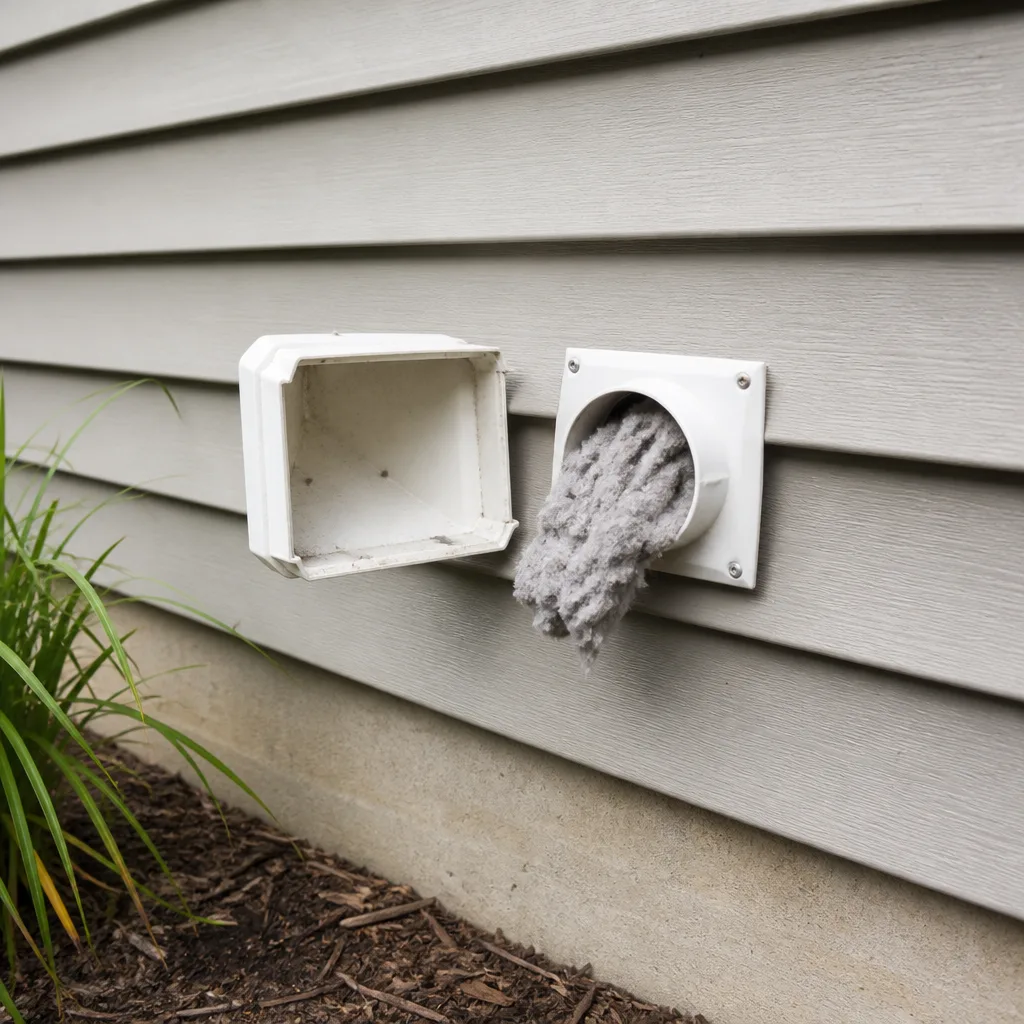 Dryer vent cleaning
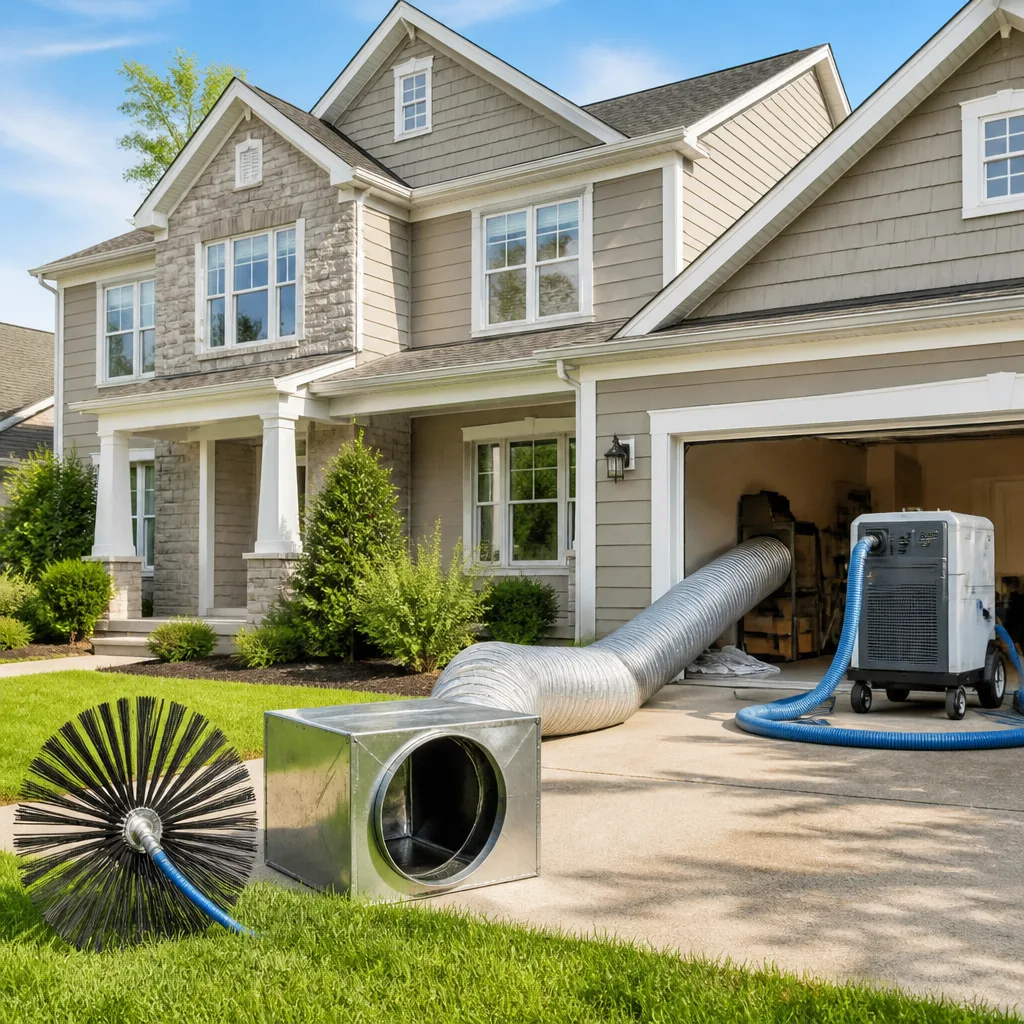 Whole-home duct cleaning
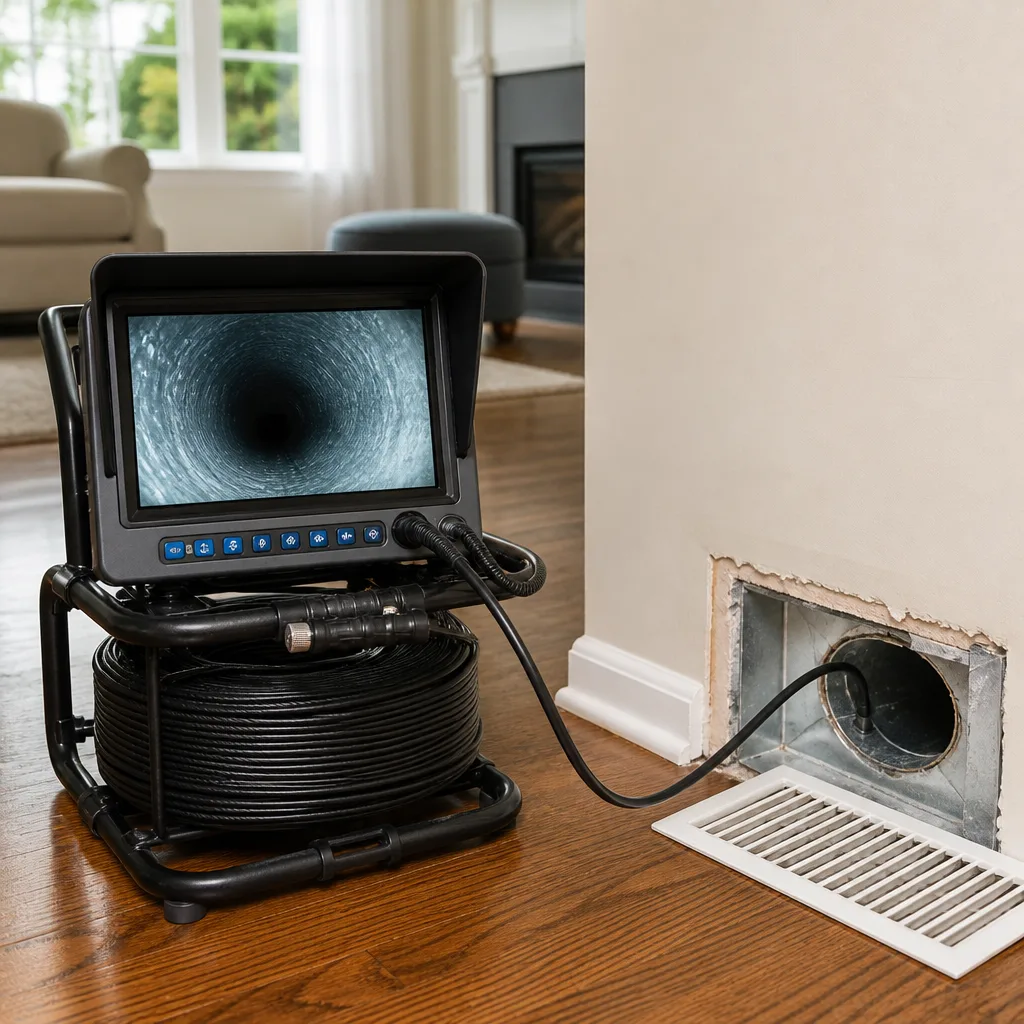 Camera inspection
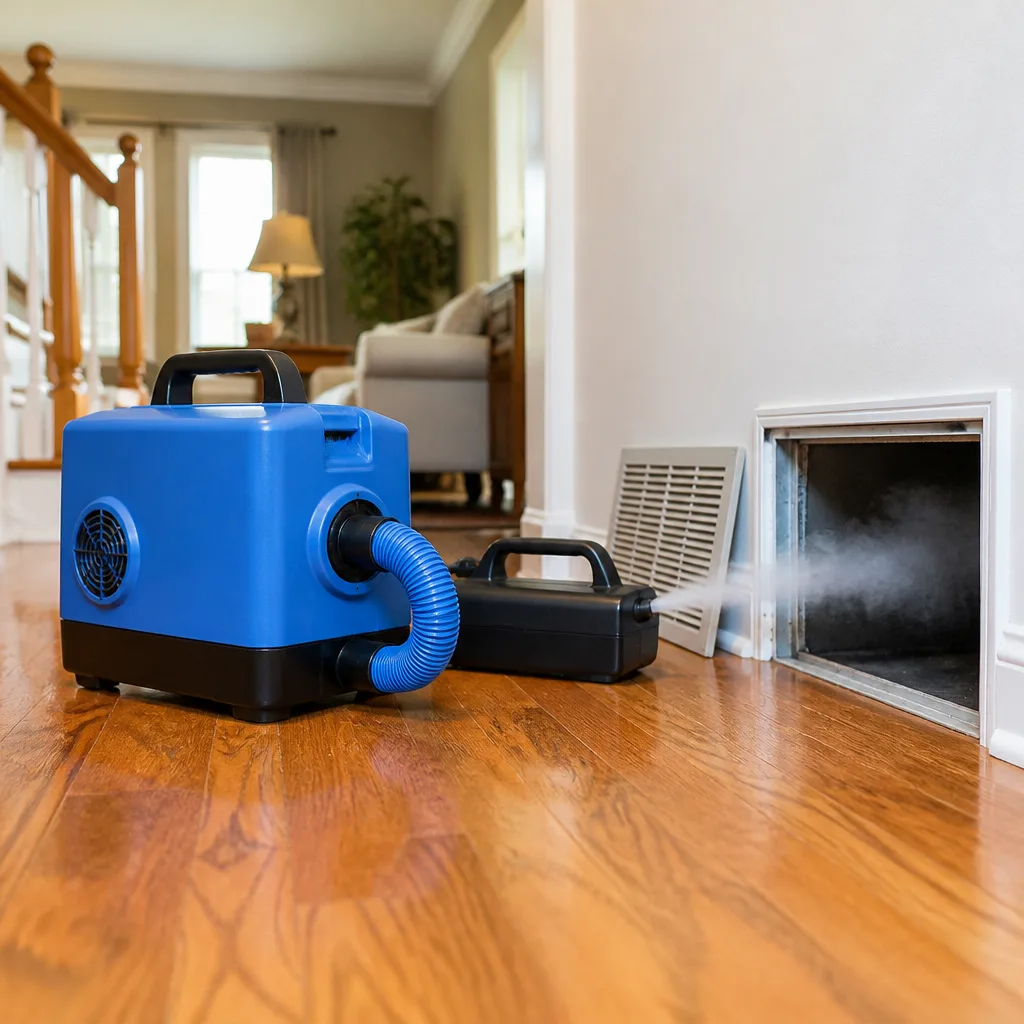 Sanitizing & deodorizing
Whole-system duct and dryer vent check with before-and-after photos - you see exactly what came out of your vents
That "$99 whole-house special" is a bait ad - the real number appears once they are in your hallway, or the "clean" is a shop-vac at the register. We photograph the inside of your ducts before and after instead.
Dryer Vent Cleaning Maintenance Checklist for Torrance Homeowners
The U.S. Fire Administration reports dryers cause roughly 2,900 home fires every year – and the No. 1 contributing factor isn’t a faulty dryer, it’s a vent that hasn’t been properly cleaned in over a year. Most Torrance homeowners do the one thing they’ve been told to do: clean the lint trap after every load. That’s good, but it addresses maybe 20% of the system. The other 80% is the 15 feet of concealed ductwork running behind the laundry wall, through the attic, or out the roof, collecting a combustible mix of lint, dust, and sometimes a bird’s nest. This guide walks through a month-by-month maintenance checklist built around the specific housing stock we work in every day here in Torrance – condos, townhomes, stacked laundry closets, and long vent runs with more bends than a single-family straight shot. By the end, you’ll know what to inspect yourself, what to leave to a pro with a scope, and what it should cost.
Styles & brands we work with
Quick Answer
A proper dryer vent maintenance plan for Torrance homeowners includes a monthly lint trap and exterior flap check, a quarterly drying time benchmark test (a standard load should dry in 35 – 45 minutes), and a professional vent cleaning every 12 months – or every 6 months if your vent run exceeds 15 equivalent feet with multiple 90-degree elbows, which is common in Torrance condos and townhomes. Professional our Dryer Vent Cleaning services in Torrance typically runs $89 – $149 for a standard accessible run.
Table of Contents
- What You Can Inspect Yourself vs. What Needs a Pro
- The Month-by-Month Dryer Vent Maintenance Checklist
- How to Measure Your Vent’s “Equivalent Length” (and Why It Matters in Torrance)
- Why Torrance Condos and Townhomes Need More Frequent Cleaning
- What Professional Dryer Vent Cleaning Actually Looks Like
- What a Video Scope Should Reveal – and What It Shouldn’t Conceal
- How Much Is Dryer Vent Cleaning in Torrance?
- Common Mistakes to Avoid
- When to Call a Professional
- Frequently Asked Questions
- The Bottom Line
What You Can Inspect Yourself vs. What Needs a Pro
Here’s the honest split. A homeowner in Torrance can handle about six maintenance tasks from inside the laundry room and from the exterior wall. A professional with a rotary brush system and a video inspection scope handles everything inside the wall cavity. Knowing the boundary keeps you safe, saves you money, and prevents the false confidence that leads to fires.
What you can do yourself, every month:
- Clean the lint trap before every load. If you see a film of lint on the mesh, hold it under running water. If water pools on the surface instead of flowing through, you’ve got invisible buildup from dryer sheet residue. Scrub it with a stiff brush and dish soap monthly.
- Check the exterior vent flap. Go outside, find the termination point (usually a plastic or metal hood on a wall or roof edge), and make sure the flap opens freely when the dryer runs and closes fully when it stops. If it’s stuck open, birds and rodents get in. If it’s stuck shut, heat builds up inside the duct.
- Benchmark drying time. Time one standard full load of towels. Write the number down. Track it month over month. When the dry time creeps from 40 minutes to 55 minutes for the same load size, that’s trapped lint adding resistance.
- Look behind the dryer. Pull the machine out once per season (carefully – don’t pinch the gas line if it’s a gas dryer). Check that the flex transition hose connecting the dryer to the wall is not kinked, crushed, or sagging. A semi-rigid aluminum pipe is code in most of California; the foil accordion type is a fire risk and should be replaced.
What requires a pro with a scope and rotary brush:
- Any duct run longer than 15 equivalent feet (see the section below on measuring yours).
- Any run with more than two 90-degree elbows.
- Any duct that exits through the roof, which is common in Torrance apartment and condo buildings.
- Any vent that hasn’t been cleaned in 18 months or more.
- Any vent that shows visible lint around the exterior hood or smells musty.
- Any situation where you hear scratching or rustling at the vent. Birds build nests in warm exterior vents all over the South Bay.
One hard rule from our technicians: if you can’t see all four feet of the flex hose and both ends of the rigid pipe, you’re guessing. Guessing is how lint accrues for a decade behind a shared wall in a Torrance condo until one load of towels becomes a structure fire. The professional dryer vent cleaning service in Torrance exists precisely because the dangerous stuff is never visible from the laundry room.
The Month-by-Month Dryer Vent Maintenance Checklist
Here’s the task-by-task schedule we recommend to every homeowner in Torrance, and it’s the same one our technicians follow when they service a property for the first time. One sheet, twelve months, no guesswork. Print it, tape it inside a cabinet door, and work through it. The full system – trap, flex hose, rigid duct run, and exterior hood – gets addressed in layers across the calendar.
- January: Deep clean the lint trap. Remove the trap, vacuum the trap channel with a crevice tool, then scrub the mesh with warm water and dish soap. Dry thoroughly before reinserting. While it’s out, shine a flashlight down into the housing. If you see wads of lint, call a pro now – that’s accumulation the trap never caught.
- February: Inspect the flex transition hose. Pull the dryer out, check for kinks or crushing, and measure the total length of flex hose between the dryer outlet and the wall. Code says it should be no longer than 8 feet. Longer than that and you’re adding resistance that traps lint faster.
- March: Run the drying-time benchmark test. One medium load of cotton towels. Time it from wet to fully dry. Write the number on a sticky note and stick it to the side of the dryer. If it exceeds 45 minutes, the vent is telling you something. If it exceeds 60 minutes, you’ve got a restriction worth investigating this month, not next fall.
- April: Inspect the exterior vent flap from ground level. Go out to the wall or wherever your vent terminates, and watch the flap while someone inside runs the dryer on the air-only cycle for 10 minutes. Flap should swing fully open with visible airflow. If it barely moves, you’ve got a partial blockage. If it doesn’t move at all, kill the cycle and call a pro. This is the month birds start nesting, so a missing or broken flap is a standing invitation.
- May: Check for moisture and mold signals. Run the dryer, then go to the laundry room and press your hand against the wall behind the dryer while the machine is running. Warm wall means the duct is leaking hot, humid air into the wall cavity. That’s a condensation and mold risk, common in older Torrance stucco homes where duct runs pass through uninsulated wall bays.
- June: Clean the dryer drum and door seal. Wipe the interior drum with a damp microfiber cloth, and run a clean dry cloth around the door gasket. The goal is to remove residual fabric softener film that traps lint and makes the dryer work harder, which pushes more lint downstream.
- July: Inspect the lint trap housing with a flashlight. This is the second trap-channel check of the year. Humidity is lower in mid-summer, so lint loosens and moves more freely – often revealing blockages that were pressed flat before. Vacuum out the channel and any area around the blower housing you can reach with a crevice tool.
- August: Count your elbows and measure your run. This is the math month. Walk the duct path as far as you can from inside the laundry room and attic (if accessible), count every 90-degree elbow, and multiply by five. Then estimate the horizontal and vertical length in feet. Add those together. That number is your equivalent length, and it determines your service frequency. See the next section for the full formula.
- September: Schedule your annual professional cleaning. Between Labor Day and Thanksgiving is the most efficient window. The weather is mild, vent runs are accessible, and most Torrance homes are between AC season and heating season. If your equivalent length is over 25 feet or you have a roof exit, schedule a second cleaning for March at this same time.
- October: Check the exterior hood for paint, stucco, or landscape growth. Moisture plus Torrance’s coastal fog means exterior vent hoods get painted or stuccoed over during exterior renovations with surprising frequency. Confirm the hood is unobstructed by exterior finishes, has a working back-draft damper, and is not the site of a new wasp or rodent nest.
- November: Post-cleaning verification. After your professional cleaning, run a drying-time benchmark on the same cotton towel load you tested in March. The time should be back to 35 – 45 minutes. Keep the before and after numbers on the same sticky note. That data tells you exactly when your vent run is trending toward the danger zone.
- December: Re-check the flex hose and wipe down the trap one more time. Holiday laundry volume doubles in most homes, and heavy comforters and blankets shed more lint than summer sheets. A clean trap and an unkinked flex hose make sure the early-season baseline you set in September holds through the busiest month of the year.
Two things to remember. First, this checklist assumes you’re a diligent DIYer who actually does these items. If you’re not – and most people aren’t – the fallback is simple: schedule a pro cleaning once a year and forget the monthly calendar. Second, everything on this list beyond the visible trap and flap is inaccessible without pulling the dryer, walking the attic, or running a scope. We maintain this list because it tells homeowners what the Cardinal Air Duct Torrance home service area sees every day: the homes that follow a schedule have dramatically cleaner runs when we scope them than the homes that skip it.
How to Measure Your Vent’s “Equivalent Length” (and Why It Matters in Torrance)
“Equivalent length” is the industry term for the real resistance your dryer vent puts on the exhaust air. It’s not just the straight-line distance from your dryer to the outside wall. Every 90-degree elbow, every vertical rise, every transition from flexible hose to rigid pipe adds drag. Lint collects wherever air slows down, which is almost always right after a bend.
Here’s the formula we use on every dryer vent cleaning job in Torrance:
- Measure the linear footage of the entire duct path, starting at the dryer outlet and ending at the exterior termination point. Include both horizontal runs and vertical rises.
- Count every 90-degree elbow. Each one adds 5 feet of equivalent length.
- Count every 45-degree elbow. Each adds 2.5 feet of equivalent length.
- Add the flex transition hose. If it’s more than 4 feet of semi-rigid aluminum or any length of foil accordion, add the full measured length – flex hose is more restrictive per foot than smooth rigid pipe.
- Add it all together. That’s your equivalent length.
Real example from a condo in central Torrance we cleaned last month: the dryer sat in a stacked laundry closet on the second floor. The rigid duct ran 14 feet horizontally to a shared wall, then turned 90 degrees up (5 feet), traveled another 6 feet vertically to the attic, turned 90 degrees again (5 feet), and ran 4 feet to a roof cap. That’s 24 linear feet plus 10 feet of elbow adds, for a 34-foot equivalent run. The recommended maximum for most residential dryers is 35 feet. That unit needs professional cleaning every six months, not annually, because the system has no margin for lint buildup before the dryer starts working against serious resistance.
Why this matters specifically in Torrance: our housing stock is dense. Condominium complexes, townhome communities, and older apartment buildings dominate the central and coastal neighborhoods. These buildings maximize square footage by stacking laundry closets on interior walls or running vents through shared chases to a roof cap. The result is more elbows per dryer vent than almost any other South Bay city. A single-family home in the Hollywood Riviera might have a short straight shot out the side wall; a stacked condo on Sepulveda Boulevard might have a vent run with four elbows and a 25-foot vertical rise. Both homes need cleaning, but one needs it twice as often.
If you can’t access the full duct path – and most condo owners can’t – our technicians measure equivalent length with a video scope during the initial inspection. The camera travels the entire run, and its distance counter gives us the linear footage while the articulation shows each elbow on screen. That’s part of every professional air duct cleaning service we provide in Torrance, and it’s the difference between guessing and knowing.
Why Torrance Condos and Townhomes Need More Frequent Cleaning
The layout of a Torrance condo or townhome almost never produces a simple vent run. Space efficiency means the dryer lives in a closet, not a dedicated laundry room with an exterior wall. That closet is usually in a hallway, against a shared wall, or stacked vertically with the unit above or below. The duct, in turn, runs through the building’s structure rather than straight out the back of the house.
What those layouts produce are 90-degree elbow bends – often three or four per run – and long vertical stretches through shared chases. Each elbow creates a slow spot. Lint drops out of the airstream at every turn. Over a year or two, those slow spots accrete lint into dense mats that can reduce airflow by 40 – 50%. The dryer compensates by running hotter and longer, and eventually the high-limit thermostat trips, the heating element fails, or lint near the dryer’s exhaust port ignites.
Here’s what we see in specific Torrance building types:
- Stacked laundry closets in condos: The dryer sits in an interior closet, and the vent runs vertically through a chase shared with the unit above or below. No exterior wall access means roof or eaves termination, meaning the duct is almost entirely concealed. Clogging can go unnoticed for years because there is no accessible mid-run point to inspect.
- Side-by-side townhomes: The vent often splits off a main run that carries halfway across the unit before turning up toward the roof. These runs commonly have two or three elbows and 15 – 25 feet of equivalent length. Annual cleaning is the minimum.
- Older Torrance apartments: Many pre-1980s buildings in the downtown corridor and along Torrance Boulevard still have original sheet-metal ductwork. These ducts weren’t sized for modern high-efficiency dryers, which push more lint per cycle than older machines. A 4-inch duct that once handled a 1970s dryer’s output is now marginal for a 2020s dryer on the same run.
- Single-family homes in South Torrance and the Hollywood Riviera: A handful of these have straight side-wall terminations under 10 equivalent feet. If you’re in that group, count yourself lucky. Your vent can tolerate annual cleaning, but the exterior flap still needs regular inspection because coastal salt air corrodes the hinge and spring mechanism faster than inland climates.
One more local factor: Torrance sits close enough to the water that the morning marine layer pushes humidity into exterior vent hoods for several hours a day, roughly 250 mornings a year. That humidity mixes with lint to form a paste-like sludge that clings to the duct walls and hardens. In drier inland climates, lint stays fluffy and blows through. In Torrance, it cakes. The only remedy is mechanical cleaning – which is exactly what a Rotobrush rotary brush system does – plus a hood that seals tightly against moisture intrusion when the dryer isn’t running.
What Professional Dryer Vent Cleaning Actually Looks Like
Here’s what should happen when you hire a dryer vent cleaning service in Torrance. We’re describing our process because it matches the professional standard – the same standard we recommend you hold any company to, ours included. If a company shows up with a shop vac and a leaf blower, tell them thanks but no.
- Inspection first, cleaning second. The technician should walk the laundry room, identify the dryer model and fuel type (gas or electric), pull the dryer away from the wall, and inspect the flex transition hose. If it’s the foil accordion type, it gets flagged for replacement; if it’s semi-rigid aluminum and in good shape, it stays.
- Video scope run through the entire duct. The camera goes in from the dryer side or the exterior hood side, and the technician should narrate what it sees. You should see the elbows, the straight sections, and any accumulated lint, dead insects, or nesting material. You should also see the exit point. If the technician doesn’t show you the scope feed, ask for it.
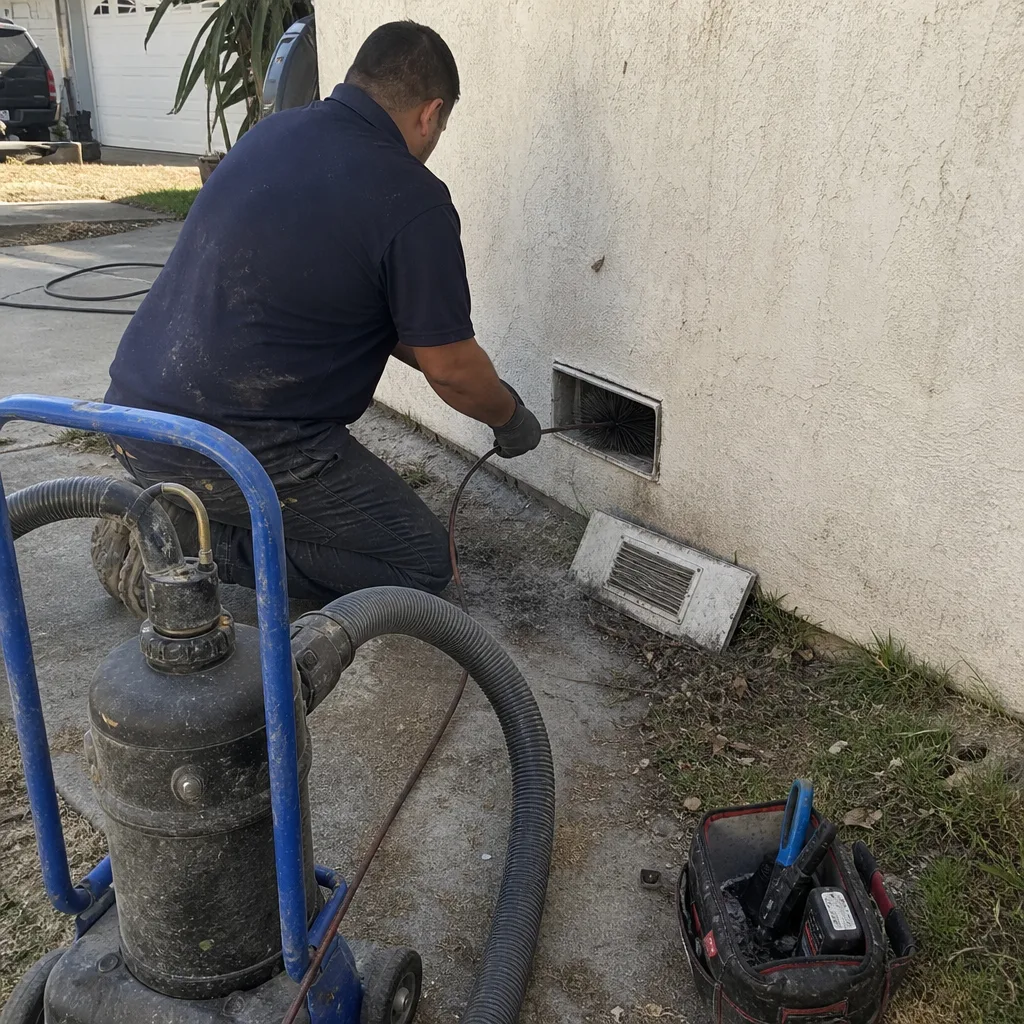
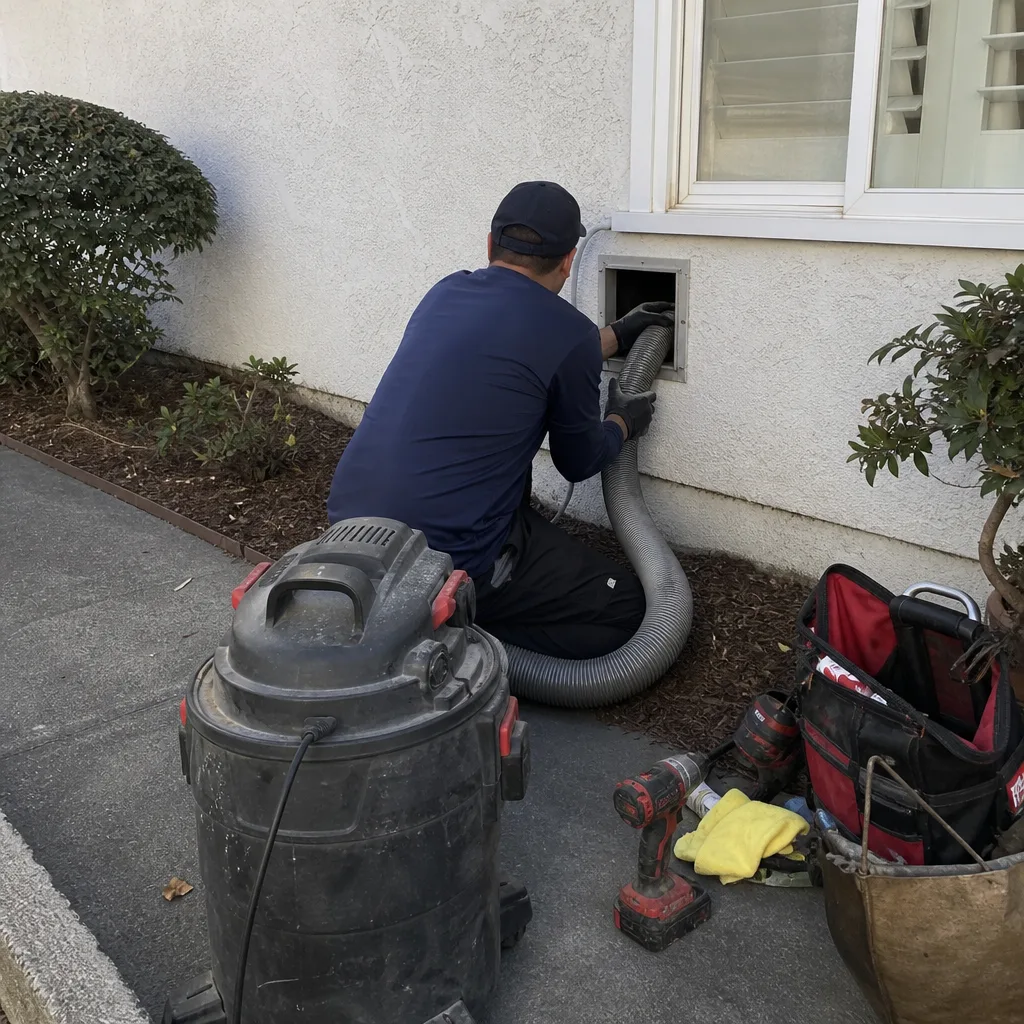
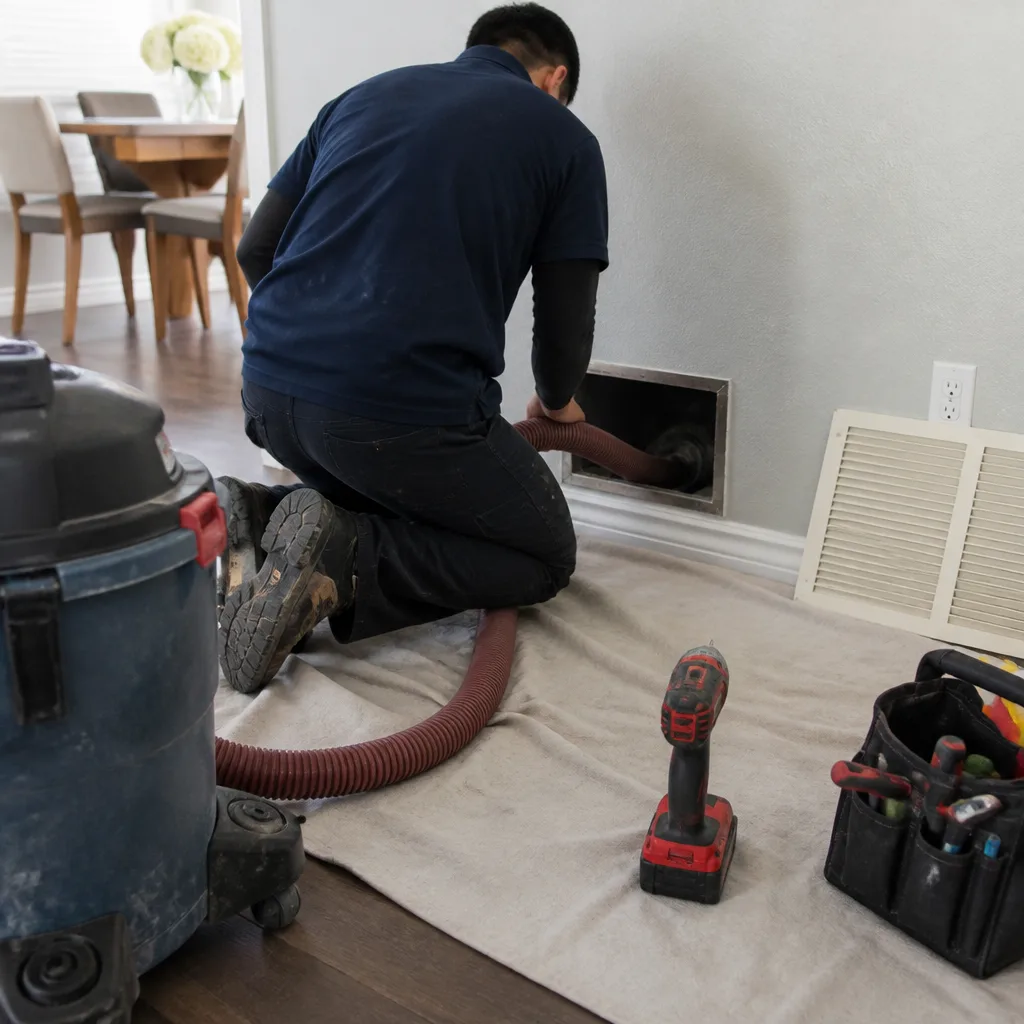
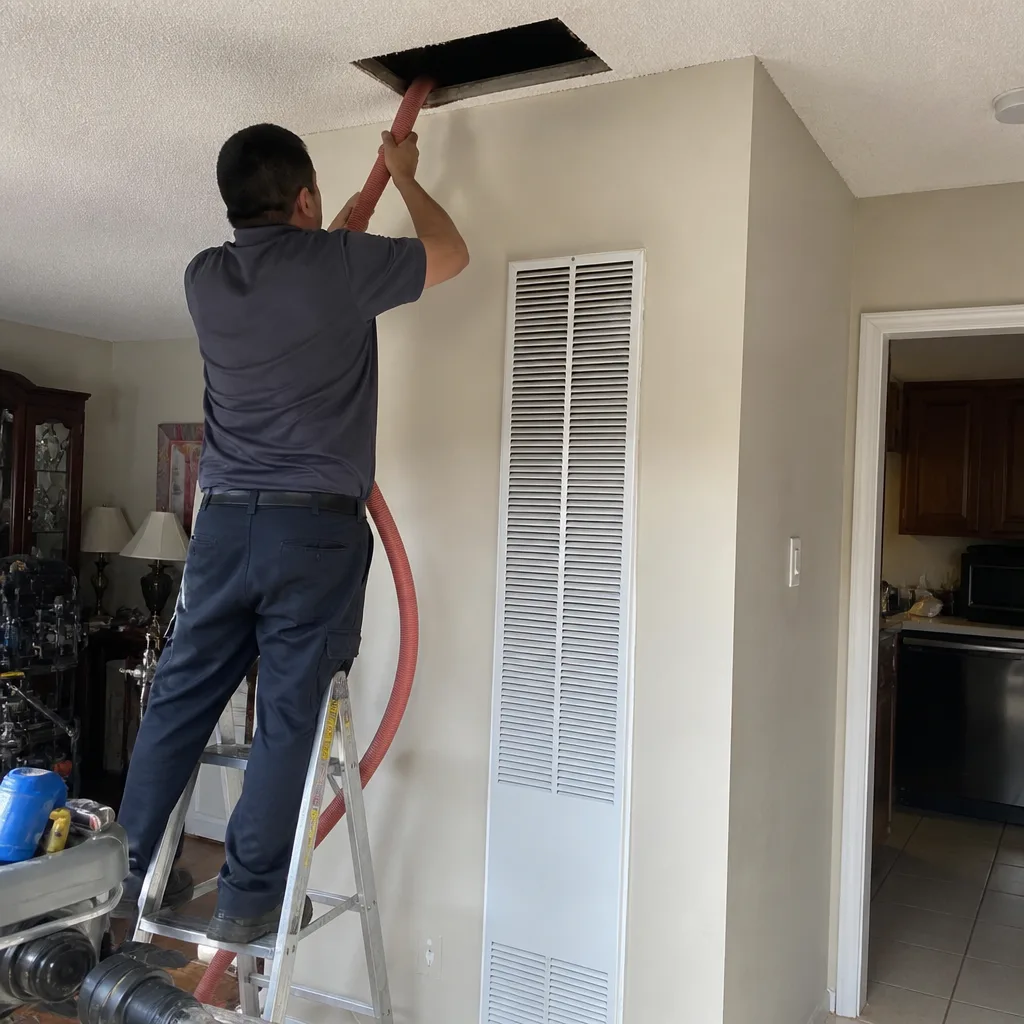
- Rotary brush cleaning under negative pressure. The technician runs a flexible shaft with a rotating brush head (we run Rotobrush brush systems) through the duct from both directions, while a Nikro HEPA vacuum pulls air backward through the line. That’s the negative-pressure extraction part – it means the loosened debris goes straight into the vacuum canister, not back into your laundry room. Two directional passes, minimum.
- Access points checked and resealed. If the duct has a clean-out access door, it’s opened, cleaned, and resealed with foil tape or a proper mechanical fitting. If the run is fully concealed, the cleaning still happens through the termination point and dryer connection, but the camera verifies the pass.
- Airflow measurement before and after. A good technician measures static pressure or airflow with a manometer or anemometer before cleaning, then again after. You should see a measurable improvement – and if you don’t, there’s a problem upstream that hasn’t been addressed.
- Before-and-after photos. You should receive photographic documentation of what the duct looked like when the camera went in and what it looked like after the final pass. We do this on every job because it’s part of The Relay Standard – the booking and service experience that our parent company, Relay Home Co., holds every independently owned location to. You see the actual work, not a report that says “cleaned.”
- Final function test. The dryer runs for 10 minutes on air-only, the exterior flap is observed to confirm it’s opening fully, and the temperature around the dryer is checked. The job’s not done until the system operates under real conditions.
Total time for a standard accessible run: 45 – 90 minutes. Total time for a condo run with a roof exit and heavy buildup: 2 – 3 hours. Either way, you should know the price before the work starts, in writing. No surprises after the fact. That’s the way we operate – and it’s why a written price and a written guarantee are built into every booking, including every HVAC cleaning service we provide in Torrance and the wider South Bay.
What a Video Scope Should Reveal – and What It Shouldn’t Conceal
A video inspection scope is the single most important piece of diagnostic equipment in dryer vent work. It’s also the piece most likely to be skipped by companies that would rather sell you a cheap cleaning and get to the next job. Here’s what you should see on the screen, and what you should walk away from.
What the scope should show you:
- The entire run from end to end. If the technician can’t show you the full path from dryer connection to exterior hood, the inspection is incomplete. That’s not negotiable for any vent in Torrance with concealed sections.
- Each elbow and transition. These are the lint collection points. You should see the camera articulate through each bend and capture stills of the interior walls at each transition.
- Any blockage or heavy buildup. Lint, lint mixed with moisture (the pasty accumulation common in coastal Torrance vents), bird nesting material, rodent droppings, or detached sections of pipe. The technician should point these out on screen and explain what they’re seeing.
- The termination point from inside. The camera should reach the exterior hood and show the flap mechanism from the inside, confirming the damper is intact and functioning. If the run terminates on a roof, the scope should reach the roof cap.
- The after photos. Same run, same angles, after the cleaning. You should see the difference. That’s the before-and-after photo documentation that’s built into every booking under The Relay Standard, and it matters for this service specifically because the work is invisible by definition. You’re paying for something you can’t see. The evidence needs to be on the screen.
What the scope should NOT be doing:
- The technician should not refuse to show you the screen. If they won’t let you watch, that’s a red flag. A legitimate technician wants you to see what they see. This is your duct, in your home, in Torrance, and you have every right to inspect it.
- The scope should not “skip” sections. If the camera goes in from the dryer side and stops halfway, then goes in from the exterior and stops at the same place, and the technician shrugs – there’s a disconnect in the pipe, a collapsed section, or a blockage the tech doesn’t want to deal with. That’s exactly the thing you’re paying to have addressed.
- The after photos should not be blurry. Blurry screenshots from a cheap camera don’t prove the work was done. We run scopes that record in full HD because the documentation has to be legible enough to prove the interior of the duct is clean at every elbow.
- The video should not be from a previous job. Ask to see the scope feed live, with the time and date visible on screen. It’s the same instinct you’d apply to any other home service. The photo evidence we deliver under The Relay Standard is from your run, on your service date, and it’s tied to the digital invoice you receive.
One more note on bird nests, because it comes up often in Torrance: the neighborhood’s mature tree canopy means we find active or abandoned bird nests in exterior vents all over town, especially in the spring and early summer. A nest is not just a blockage – it’s a fuel source pressed directly against heated air. The scope shows it; the rotary brush and HEPA vacuum remove it; and a new exterior hood with a proper bird-guard damper prevents the next one. If you hear scratching at the vent, show it to your technician on inspection day.
How Much Is Dryer Vent Cleaning in Torrance?
Here’s the straight answer. Professional dryer vent cleaning in Torrance typically runs $89 – $149 for a standard accessible run under 15 equivalent feet with no complicating factors. That includes the full service: video inspection, rotary brush cleaning under negative pressure, both direction passes, airflow measurement, and before-and-after photo documentation. Most single-family homes with a side-wall or rear-wall termination fall into this range.
What pushes a job above that range:
- Longer runs: Every additional 10 feet of equivalent length adds time and effort. A 35-foot condo run with three elbows is not a $99 job, and anyone quoting $99 for that run sight unseen is going to change the price at the door. That’s the bait-and-switch pattern this industry is known for, and it’s precisely why we hand you a written price before a single duct is touched.
- Roof exits: Accessing a roof cap requires ladder work, safety tie-offs, and often a two-man crew. Expect a meaningful upcharge for roof-terminated vents, which are common in multi-story Torrance condo buildings.
- Bird nest removal: If the scope shows nesting material that needs to be extracted, that’s extra labor. We remove the nest and install a bird-guard damper, and we show you the photos to prove the run is clear afterward.
- Disconnected or crushed duct sections: If the scope reveals a separation or collapse inside the wall, the cleaning becomes a repair job. You need the duct reconnected before cleaning can be completed effectively, and that costs more than a standard pass.
- Second-floor or stacked laundry access: The dryer may need to be pulled from a tight closet, or the termination may be inaccessible from ground level, requiring additional equipment and time.
A note on discount pricing. The national average for professional dryer vent cleaning is around $130, and Torrance tracking trending across The Relay Home Co. locations is in that same band. When you see a $49 or $59 dryer vent cleaning coupon, you’re looking at a lead-generation price designed to get a technician into your home, at which point the real invoice appears. The vent is then “discovered” to be longer than expected, or need extra passes, or have a “blockage” that costs extra. We don’t play that game. The price is written before work starts and it doesn’t change at the door. If the scope finds something unexpected, we show you on screen and quote the fix before we do the work, not after.
For an exact quote on your vent run, call (424) 488-0361. Estimates are free and a live person answers.
Common Mistakes to Avoid
- Treating the lint trap as the whole job. The trap catches maybe 20% of the lint the dryer produces. The rest sails into the duct. Monthly trap cleaning is necessary but nowhere near sufficient, especially on the longer runs typical in Torrance’s attached housing.
- Using a leaf blower or shop vac from the exterior as a DIY fix. Both push air in the wrong direction or pull too weakly to break up the hardened lint-paste that forms in coastal humidity. Worse, reverse airflow can blow lint into the dryer cabinet and around the heating element, creating an immediate fire risk.
- Ignoring the foil accordion flex hose. The white or silver foil hose behind the dryer is a known fire hazard and is against code in most of California for new installations. If yours is still there, it’s been there too long. Replace it with semi-rigid aluminum before the next laundry day.
- Assuming a roof vent is cleaner than a wall vent. Roof vents collect lint, bird nesting, and moisture at the cap, and they sometimes go years without inspection because nobody wants to climb up. In Torrance’s condo-heavy housing stock, roof vents are common – and they fail silently.
- Believing a company that quotes a set price before knowing your address. A serious contractor asks about your home: attached or detached, interior laundry closet or exterior wall, roof or wall termination, approximate age of the dryer. If the price is fixed before any of that is known, the company is selling a lead, not a service. You’ll see the upsell when the tech arrives.
- Skipping the after-photos. If a company doesn’t offer before-and-after photo documentation, assume the reason is calibration, not convenience. A job done right produces evidence on a screen. Every booking with us includes photos because The Relay Visibility Guarantee requires it: live trackable arrival time, photo proof, and a digital invoice payable by link. That’s the standard.
When to Call a Professional
Call a pro when any of these conditions shows up: drying times consistently exceed 45 minutes for a standard towel load, the exterior flap doesn’t open during the cycle, visible lint accumulates around the exterior hood, the laundry room smells musty when the dryer runs, the dryer shuts off before clothes are dry, or you know the vent hasn’t been cleaned in more than 18 months. Any one of those is a signal; several together is the system telling you it’s failing. Don’t wait for the dryer to throw a code – those codes often come after the restriction has already damaged the heating element or tripped the thermal fuse. Cardinal Air Duct Torrance offers free estimates in Torrance – call (424) 488-0361 and a live person will answer, ask the right questions about your home’s setup, and get you a written price before scheduling.
Frequently Asked Questions
Every 12 months for most single-family homes with a straight run under 15 equivalent feet, and every 6 months for condos, townhomes, or any home with multiple elbows, a roof exit, or a run over 25 equivalent feet. Torrance’s combination of dense attached housing and coastal humidity means many homes fall into the every-6-months group. If you’re not sure which group you’re in, call (424) 488-0361 and we’ll help you estimate your run over the phone.
Professional dryer vent cleaning in Torrance typically costs $89 – $149 for a standard accessible run. Longer runs, roof exits, bird nest removal, and repairs push the price higher, and those are quoted after a video inspection shows exactly what’s in your duct. The quote is written and free – call (424) 488-0361 for an exact number on your home.
The most common cause in Torrance homes is a partially blocked dryer vent, not a failing heating element. Lint builds up at every elbow in the duct, restricting airflow and forcing the dryer to run longer and hotter. Before you replace the dryer, have the vent scoped. If the restriction is cleared and drying times don’t improve, the dryer itself becomes the next suspect.
Yes. The lint trap catches a fraction of the lint your dryer produces. The rest travels downstream into the duct and accumulates at bends, transitions, and the exterior hood. Trap cleaning is a daily habit; vent cleaning is a yearly (or twice-yearly) service. They address different parts of the system and both are required.
You can, but only partially. A hardware store brush kit reaches the first few feet of a straight run. It won’t break up hardened lint in long sections, navigate multiple 90-degree elbows, or reach a roof cap. For short straight runs under 10 equivalent feet, a DIY pass every six months plus a pro cleaning every two years is a defensible plan. For anything longer or with multiple bends – which describes most Torrance condos – go straight to a pro with a rotary brush system and a video scope.
Yes. We work across Torrance – from the South Bay neighborhoods to Old Torrance, from the Hollywood Riviera to the Wilson Park area – and we service condos, townhomes, apartments, and single-family homes. Every job includes a written price before work starts, a written guarantee on every repair, and before-and-after photo documentation. Call (424) 488-0361 and you’ll reach a live person.
The Bottom Line
A dryer vent that hasn’t been cleaned in over a year is a fire hazard with a lint trap attached. The maintenance checklist for Torrance homeowners boils down to three habits: clean the trap every load, benchmark drying time every quarter, and schedule a professional cleaning every 12 months – or every 6 months if your vent run is long, twisted, or roof-terminated. Measuring your run’s equivalent length tells you which schedule you’re on. A video scope tells you what’s actually in there. And before-and-after photos tell you the work was done right. The whole system is visible if you demand it. For a free estimate on your home, call (424) 488-0361.
Written by Omar Haddad, Owner at Cardinal Air Duct Torrance, serving Torrance since 2005.
See the difference
 Before
 After
After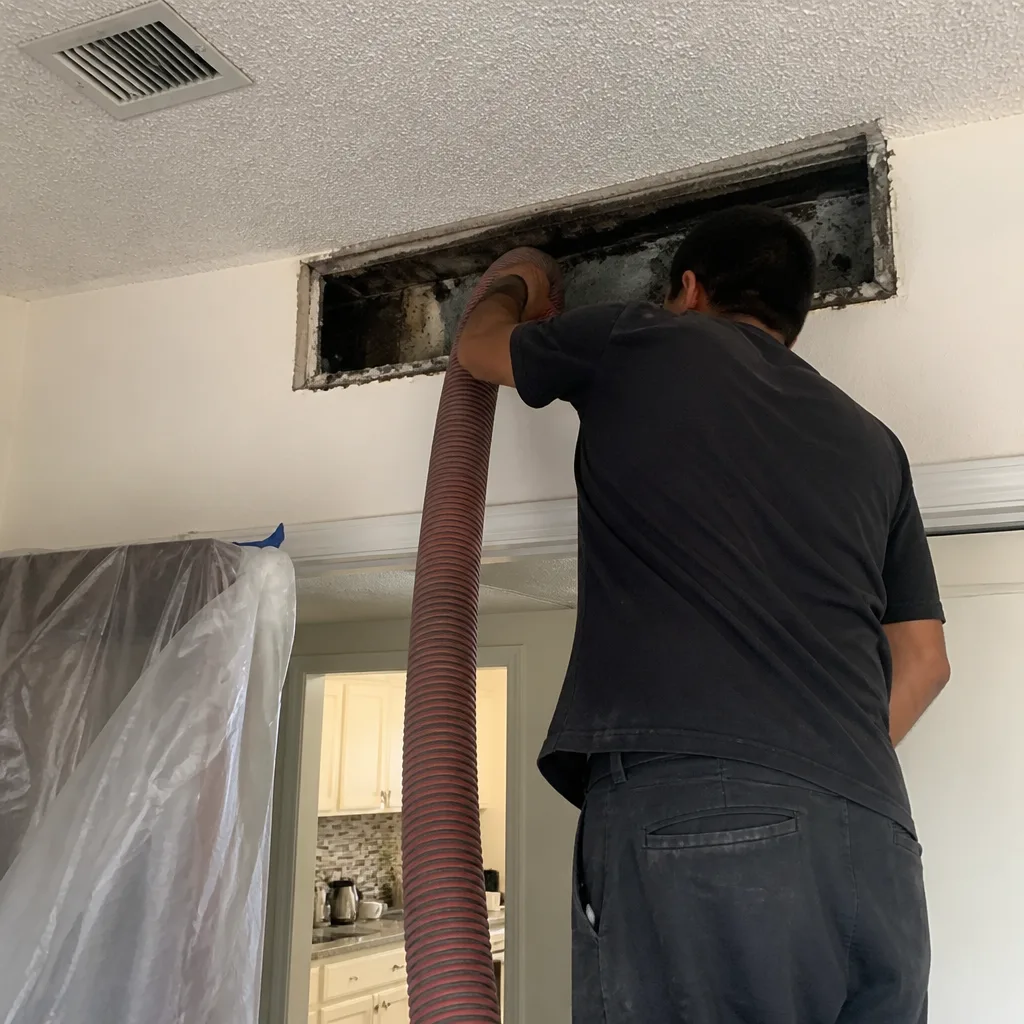 Before
 After
After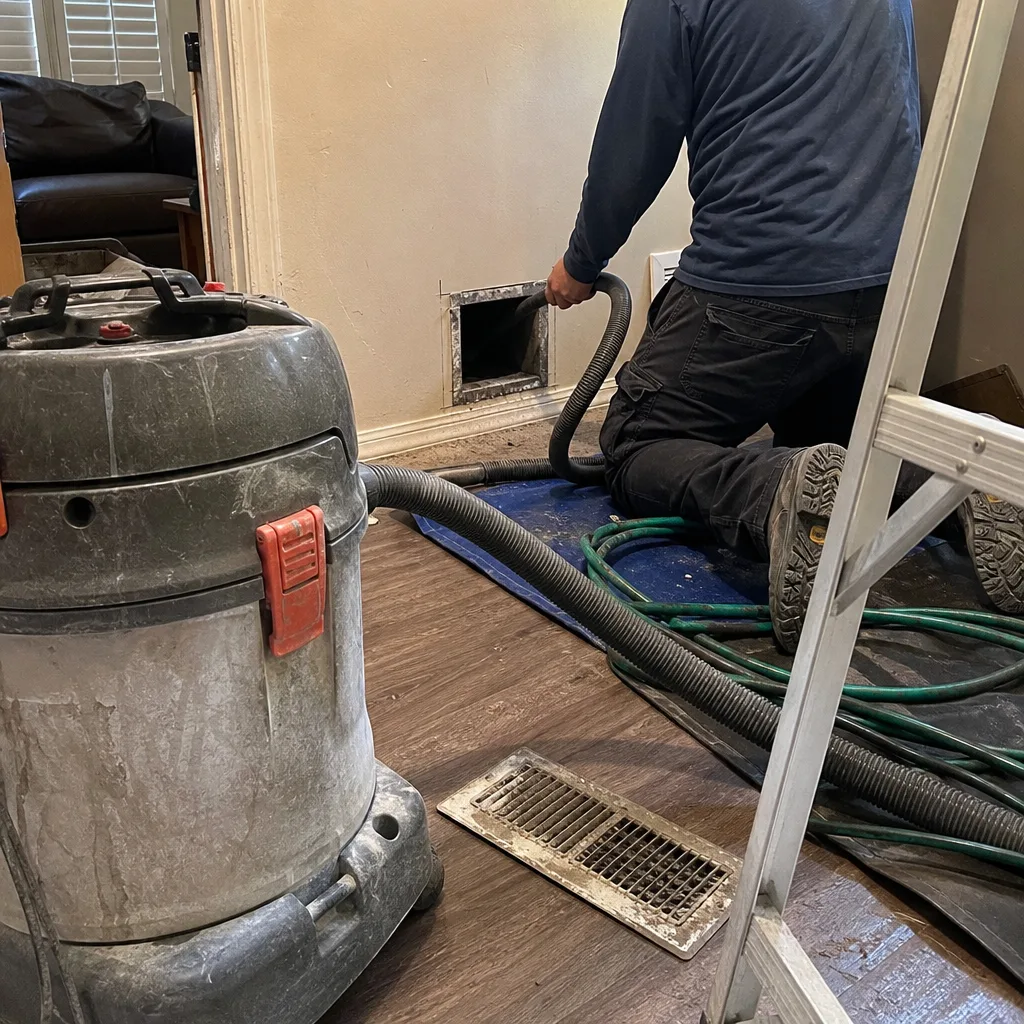 Before
 After
After