
Last updated October 15, 2026
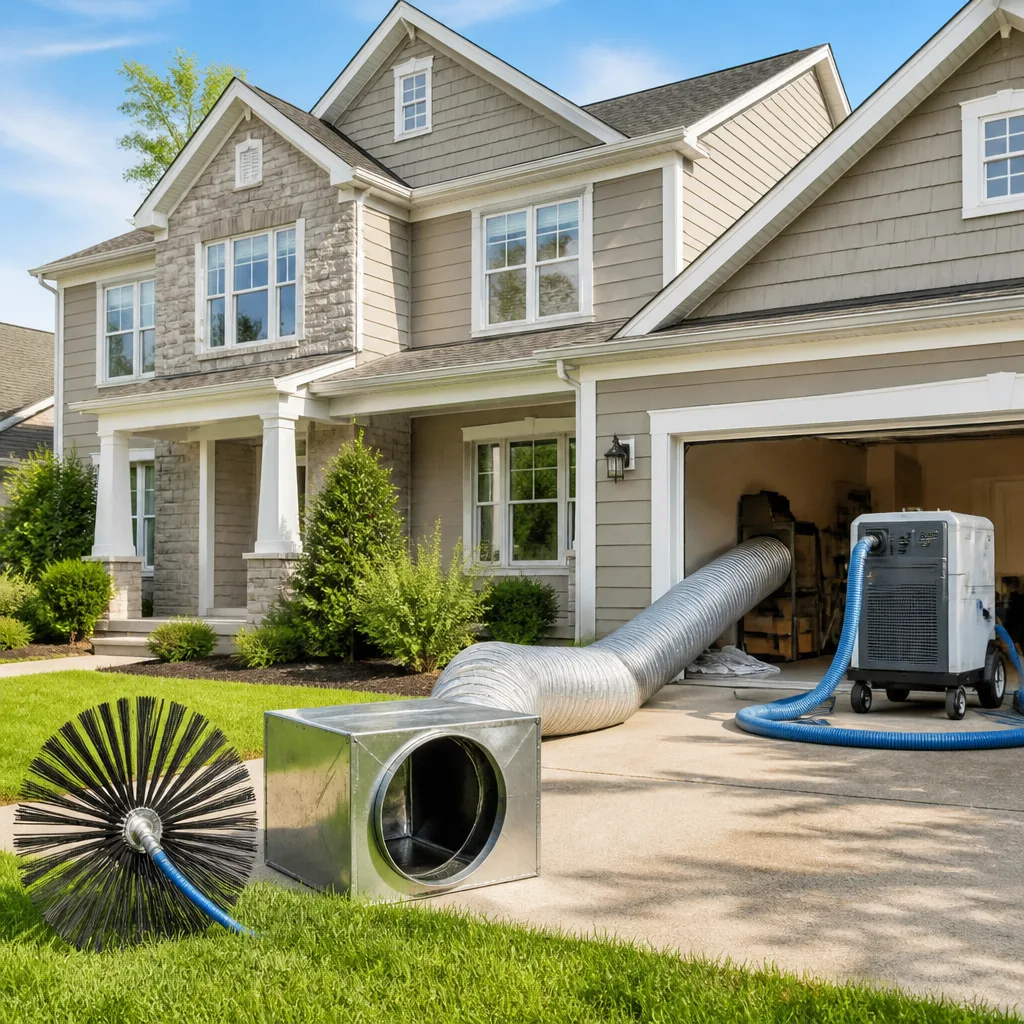 Whole-home duct cleaning
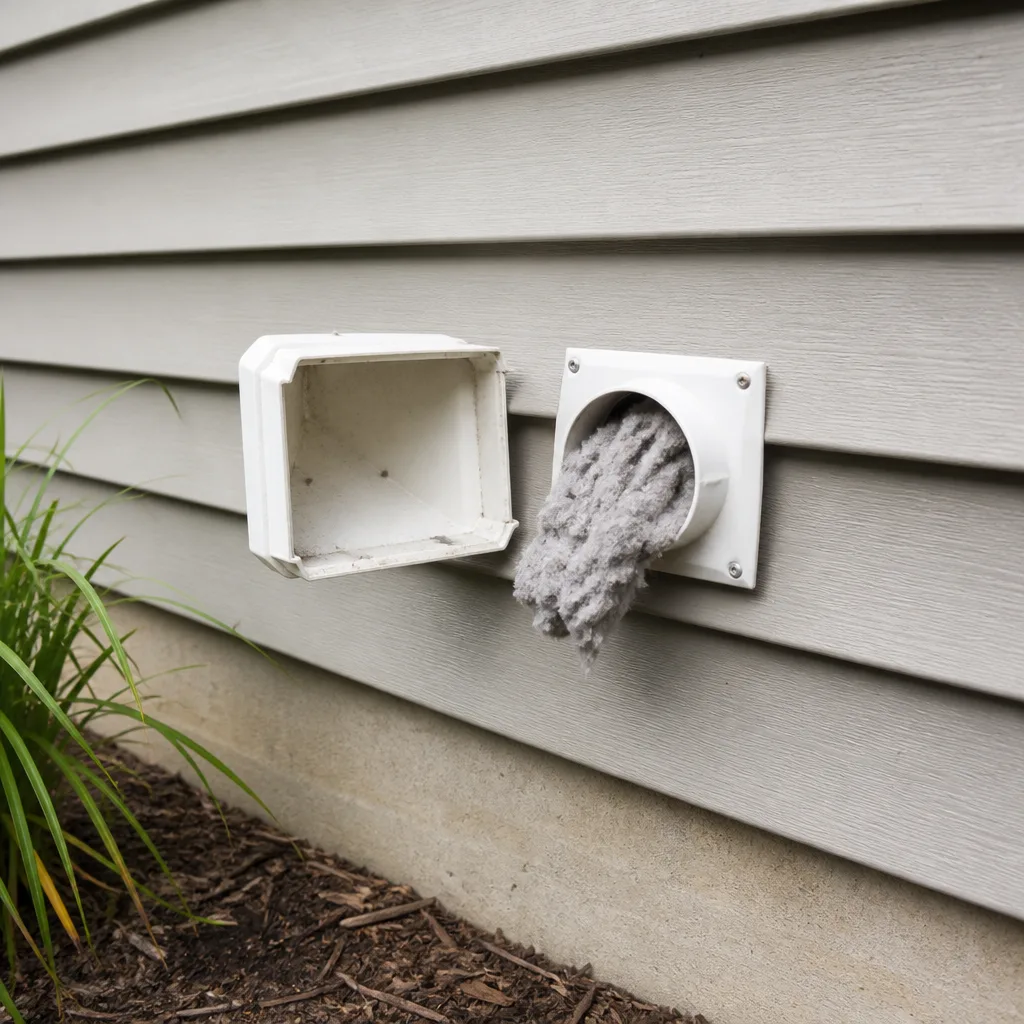 Dryer vent cleaning
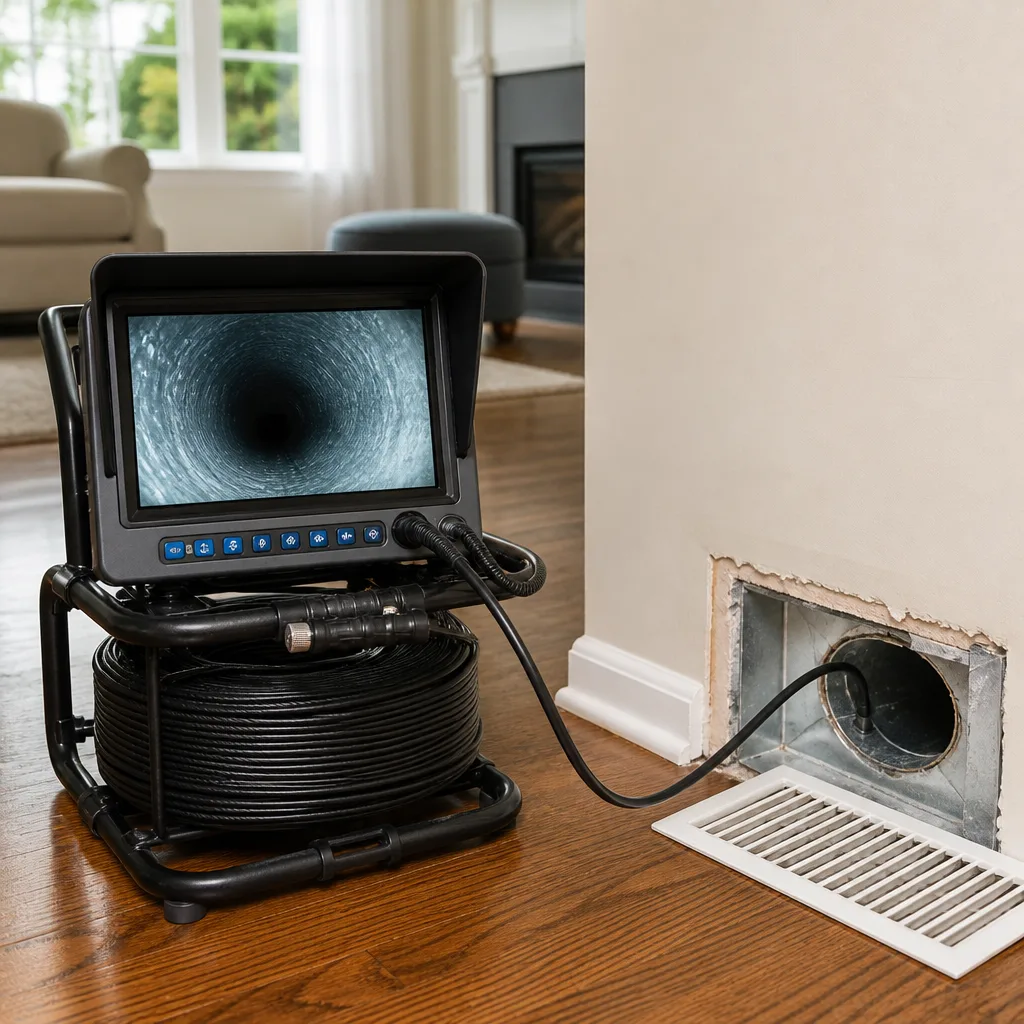 Camera inspection
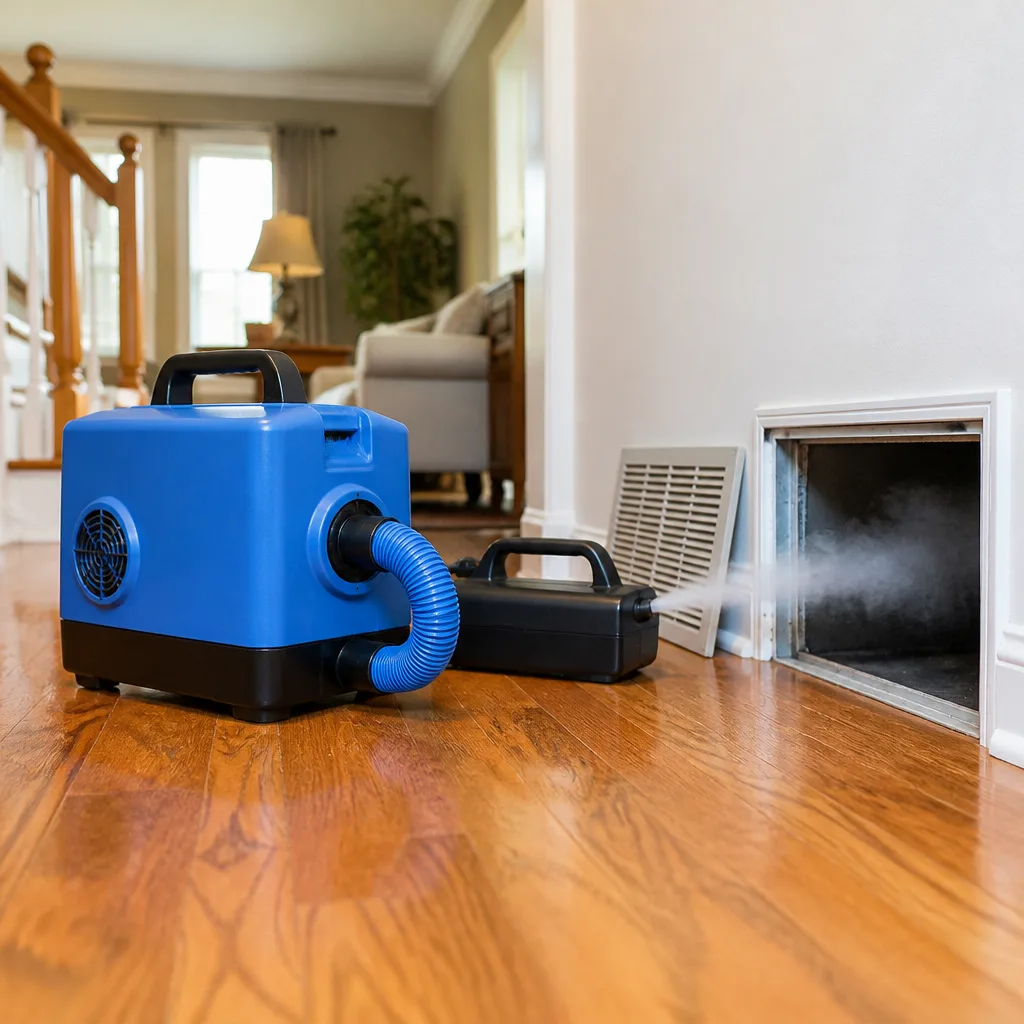 Sanitizing & deodorizing
Whole-system duct and dryer vent check with before-and-after photos - you see exactly what came out of your vents
That "$99 whole-house special" is a bait ad - the real number appears once they are in your hallway, or the "clean" is a shop-vac at the register. We photograph the inside of your ducts before and after instead.
DIY vs Professional Air Duct Cleaning: The Torrance Homeowner’s Decision Guide
Here’s a number most Torrance homeowners never hear: the air inside a typical South Bay home cycles through the ductwork 5 to 7 times every day, and a single filter change skips the 30 to 40 feet of duct walls where the real accumulation happens. Most people assume duct cleaning is either a total scam or a must-do-every-year service. Neither is true. This guide breaks down exactly which duct maintenance tasks you can confidently handle yourself in Torrance, which ones quietly make things worse when attempted with consumer tools, and where the genuine line sits between a Saturday DIY project and a call to a professional for Air Duct Cleaning with a Rotobrush system and negative-air extraction unit.
Quick Answer
DIY duct maintenance in Torrance genuinely works for three tasks: cleaning registers and grilles, replacing filters on schedule, and inspecting the exterior dryer vent cap. But the interior duct walls should be left to a professional with a negative-air machine, because a shop vac and brush kit will dislodge debris into your living space rather than extract it. For most Torrance homes with good DIY habits, professional Air Duct Cleaning in Torrance is genuinely needed every 3 to 5 years, not annually.
Styles & brands we work with
Table of Contents
- The Three Duct Tasks You Should Absolutely DIY
- The Torrance Filter Replacement Schedule (And Why It Matters)
- Why Your Shop Vac Can’t Clean Duct Walls (The Negative-Air Reality)
- What Professional Equipment Actually Does That Consumer Tools Can’t
- Torrance’s 1960s – 70s Flex Duct Problem
- The Real Cost-vs-Value Calculation for Torrance Homes
- Common Mistakes to Avoid
- When to Call a Professional
- Frequently Asked Questions
The Three Duct Tasks You Should Absolutely DIY
Let’s be direct: some duct maintenance tasks belong in homeowner hands, and doing them consistently will stretch the interval between professional cleanings from every 1 to 2 years to every 3 to 5. Here’s the honest list of what a Torrance homeowner can and should handle.
1. Register and grille cleaning (do this twice a year)
Your supply registers and return grilles collect a visible film of dust, pet hair, and cooking residue within months. Cleaning them is straightforward, low-risk, and genuinely effective. Here’s the step-by-step:
- Turn off your HVAC system at the thermostat so no air is moving through the ducts while you work.
- Unscrew each register or grille. Most Torrance homes use standard Phillips-head screws, though some mid-century homes in neighborhoods like Seaside Ranchos and Old Torrance still have original slotted screws.
- Soak metal registers in warm water with a few drops of dish soap for 10 minutes. For stubborn grime, a soft-bristle brush works. Rinse and dry fully.
- Vacuum the visible duct opening as far as your vacuum hose comfortably reaches, usually 6 to 10 inches.
- Reinstall registers once dry and turn the system back on.
That’s it. This task takes 30 to 45 minutes for a typical 3-bedroom Torrance home and removes a meaningful amount of debris from the airstream before it reaches the deeper duct walls.
2. Exterior dryer vent cap inspection (quarterly if you run laundry daily)
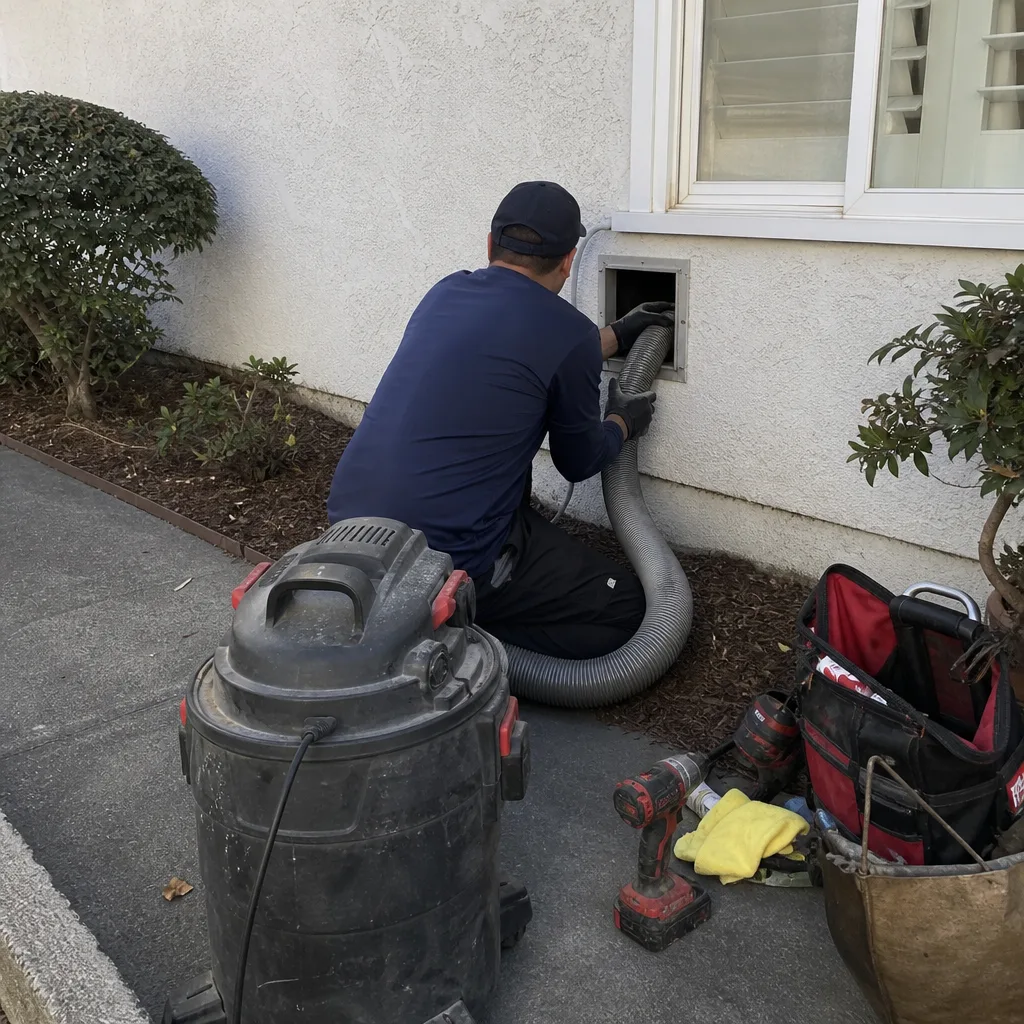
Torrance households with kids, beach towels, and workout clothes run dryers heavily, and lint accumulation at the exterior vent cap is the first place clogs form. Walk outside, locate the vent cap, and check that the flap opens freely during a dryer cycle. If it’s stuck open, lint and moisture are backdrafting. If it’s stuck closed, airflow is restricted either way, both are problems. While you’re outside, take a look at whether lint is visible around the cap opening. A small brush or your vacuum’s crevice tool clears surface buildup in under a minute. This is related to but distinct from full Dryer Vent Cleaning in Torrance, which requires interior line cleaning and should be done professionally every 12 to 18 months.
3. Visual inspection of accessible duct runs
In Torrance homes with crawl spaces, attic access, or exposed ductwork in the garage, a quarterly visual check catches problems early. Look for: sagging flex duct sections, visible tears or punctures, disconnected joints, and dark staining that suggests moisture intrusion. You’re not fixing these yourself, but catching a torn flex duct in the garage in spring before summer cooling season means a smaller repair bill than discovering it in August when your system is working twice as hard.
Here’s a common scenario we’ve seen in Torrance homes with original ducting: a homeowner notices a sagging flex duct in the attic, ignores it for a season, and by the following year that sag has accumulated enough dust and moisture to become a full restriction. Early detection costs a repair visit. Late detection costs a repair plus a cleaning plus higher energy bills for the months in between.
The Torrance Filter Replacement Schedule (And Why It Matters)
Filter replacement is the single highest-impact DIY task for indoor air quality and system longevity, and it’s the one most homeowners do inconsistently. In Torrance’s climate, which brings moderate humidity from the Pacific and significant wildfire smoke drift during late summer and fall, filters work harder than the national average.
Here’s the schedule that matches Torrance conditions:
- Standard 1-inch fiberglass filters: Replace every 30 days, no exceptions. These filters catch large particles only and load up fast.
- 1-inch pleated filters (MERV 8 – 11): Replace every 60 to 90 days. If you live near the 405 or 110 corridors in Torrance, or if wildfire season is active, check at 45 days and replace if visibly dirty.
- 4-inch media filters (MERV 11 – 13): Replace every 6 months. These are the standard in many newer Torrance homes built after 2000, especially in developments like Southwood and Walteria.
- Homes with pets or allergy-sensitive occupants: Cut every interval by roughly one-third. A home with two dogs and a MERV 8 filter in central Torrance will load that filter in 45 to 60 days, not 90.
Brands like Honeywell and Aprilaire make filter lines that fit most Torrance HVAC systems, and we’ve found that homeowners who standardize on one brand and keep a 12-pack in the garage change filters far more consistently than those who buy one at a time. When a filter change takes 60 seconds because the replacement is already on-site, it gets done. When it requires a Home Depot run, it gets postponed.
The filter’s real job goes beyond air quality. A loaded filter forces the blower motor to work harder, which drives up energy consumption and shortens motor life. In Torrance, where summer AC usage runs roughly May through October, a clogged filter in July costs real money every week.
Why Your Shop Vac Can’t Clean Duct Walls (The Negative-Air Reality)
This is the technical heart of the DIY-vs-professional question, and it’s the part most guides gloss over. Here’s the physics in plain language: effective duct cleaning requires the system to be under negative pressure while the interior is agitated. Negative pressure means air is being pulled out of the duct system faster than it’s being disturbed, so loosened debris travels in one direction only: into the vacuum, not back into your living room.
A shop vac, even a strong one rated at 100 to 150 CFM, pulls air through a 1.5-inch hose from a single access point. It creates suction at the hose tip, but it does not pressurize the entire duct run negatively. When you agitate dust off a duct wall 20 feet from the hose opening, that dust has nowhere to go but the air around it. Much of it resettles further down the duct. A meaningful portion of it, especially the fine particulates under 10 microns, escapes through register openings and into the home’s air.
Here’s the part that surprises most Torrance homeowners: the dust you can see being pulled into the shop vac is the coarse stuff. The invisible fine particles, the ones that trigger allergy and asthma responses, are the ones that stay airborne and redistribute through the house. You finish a weekend of “cleaning” and notice the house smells dustier and the air feels heavier for the next two weeks. That’s not your imagination. That’s the exact opposite of the goal.
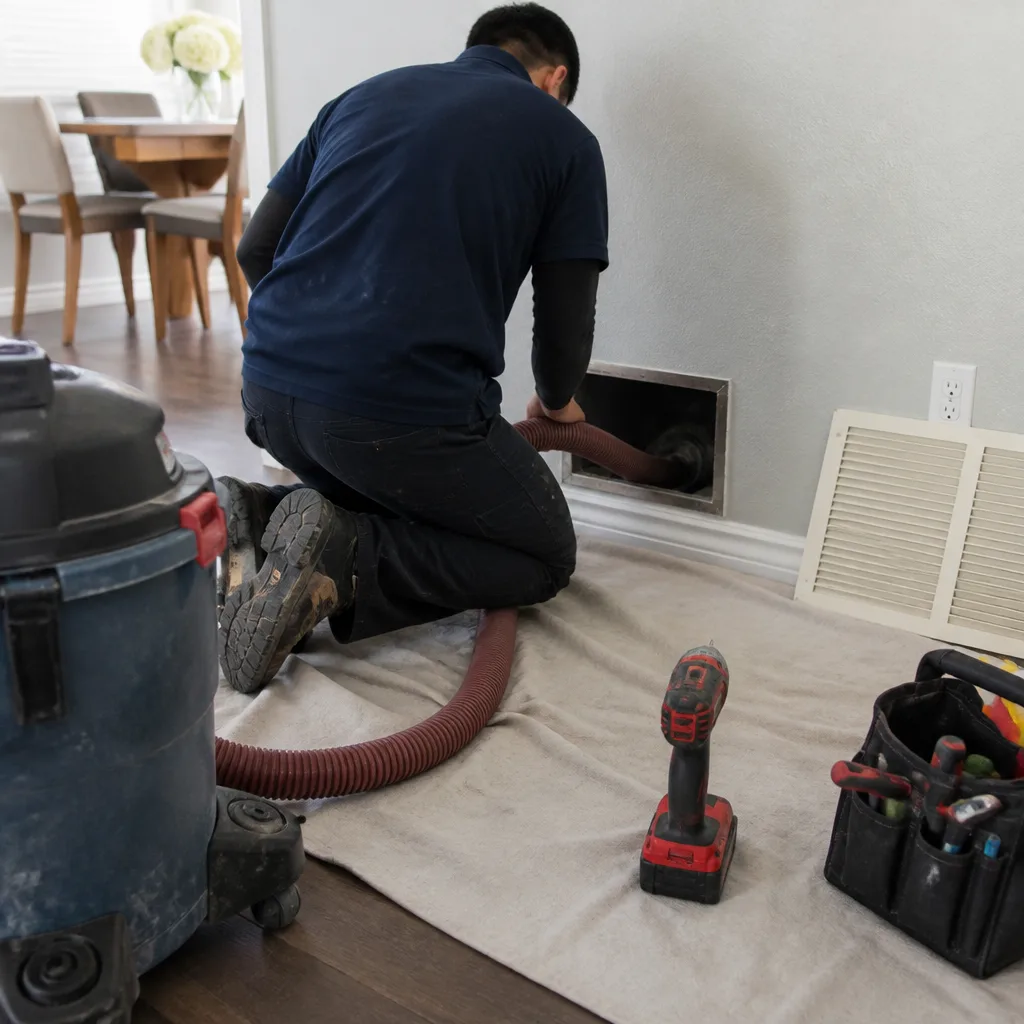
Professional systems solve this with a dedicated negative-air machine, typically rated 150 to 220 CFM or higher, connected at the main trunk line. This creates continuous suction throughout the entire duct system during agitation. We run Nikro HEPA-rated vacuum units on our jobs, and the difference is structural: the system is under suction before brushing begins, stays under suction throughout, and remains under suction for a period after brushing ends to capture anything still settling. A consumer tool cannot replicate this, not with adapters, not with a second hose, not with a more expensive shop vac.
What Professional Equipment Actually Does That Consumer Tools Can’t
The second half of the professional equation is agitation. Duct walls accumulate a baked-on film, not just loose dust. Years of conditioned air moving through ducts deposits a layer that bonds to the metal or flex material. Loose brushing knocks some of it free. Effective agitation removes the film.
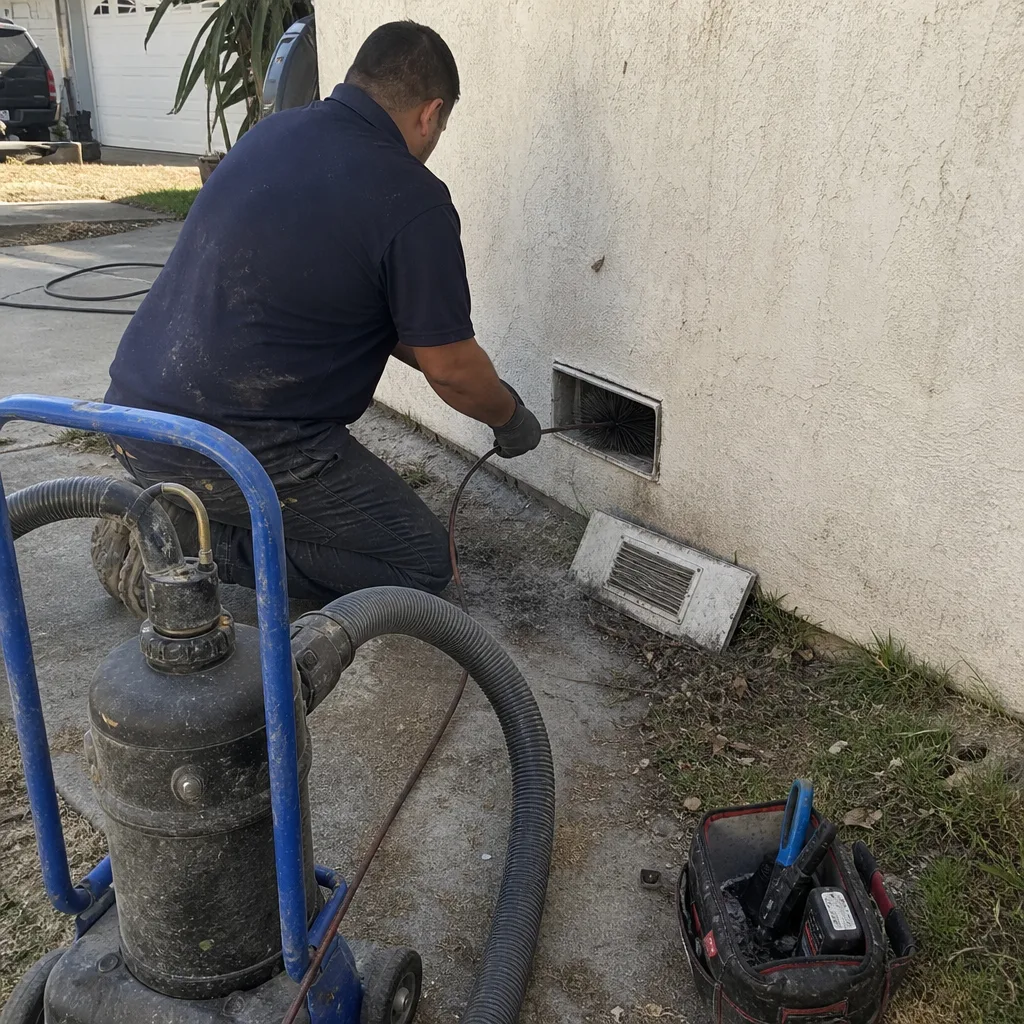
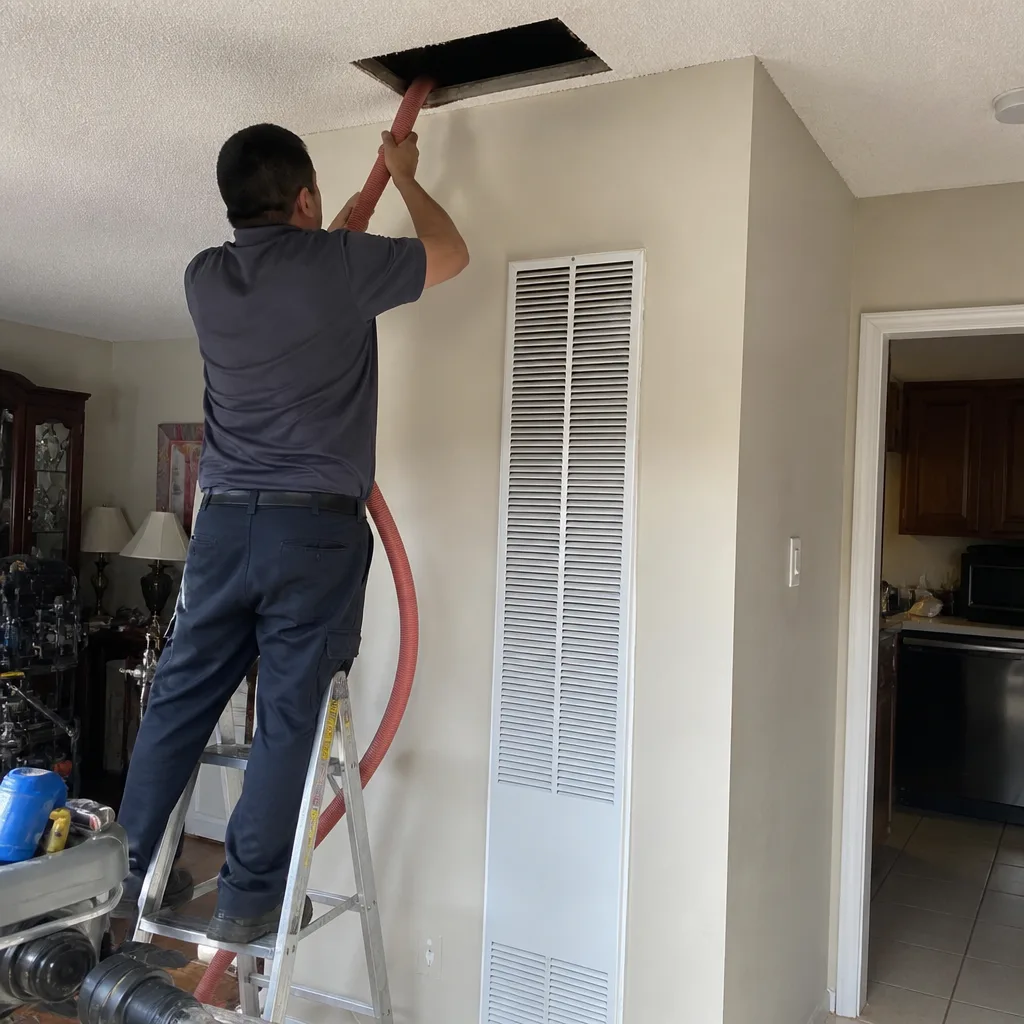
A Rotobrush rotary brush system combines a spinning brush head with integrated vacuum suction in a single tool. The brush physically scrubs the duct walls while the vacuum, connected to the negative-air machine, extracts loosened debris simultaneously. The brush head is sized to the duct dimensions and rotates at a speed that cleans without damaging the duct material. For flex duct, which Torrance homes from the 1960s through the 1990s commonly have, the tool operates at lower speeds with softer bristle configurations to avoid tearing.
We also use Abatement Technologies containment units on projects where duct contamination is significant or where the homeowner has specific allergy or respiratory concerns. Containment creates a sealed work area around the access point, which prevents any debris from entering the living space during setup and takedown. This is standard practice on commercial and healthcare jobs, and we apply it on residential work where the situation calls for it.
Here’s the plain-language version of what professional equipment delivers that consumer tools cannot:
- Full-system suction before, during, and after agitation – debris moves one direction only, out of the home.
- Continuous rotary agitation – the baked-on film comes off, not just the loose surface dust.
- HEPA filtration at the vacuum outlet – particles down to 0.3 microns are captured, not exhausted back into the home or onto the driveway.
- Visual documentation – before-and-after photos from inside the duct, which is the only way to verify the walls actually changed.
No Home Depot kit, no rented tool, and no number of YouTube tutorials replicates this combination. The question isn’t whether a homeowner can get a brush into the duct. The question is whether the debris comes out of the home or merely moves around inside it.
Torrance’s 1960s – 70s Flex Duct Problem
Torrance grew fast between 1955 and 1980, and a huge portion of the housing stock from that era used flex duct, the flexible insulated tubing that connects rigid trunk lines to individual room registers. Walk through neighborhoods like North Torrance, Seaside, or the area around Torrance High School, and the homes you see very likely contain original or near-original flex duct.
Here’s what age does to flex duct: the inner liner, usually a thin plastic or foil material, becomes brittle over decades of exposure to conditioned air and attic heat. The wire coil that gives the duct its shape stays intact, but the liner develops micro-cracks and weak points. In a 55-year-old flex duct, that liner can tear under surprisingly little force, a firm tug from a brush head, a snag on an internal seam, even the vacuum pressure from a consumer wet/dry vac pushed into the duct opening.
When a flex duct tears, the problem escalates immediately. The system draws attic air into the duct run, pulling in insulation fibers, pest debris, and unconditioned air. The room connected to that duct gets less airflow. The system works harder to maintain temperature. And you’ve created a problem that requires professional repair, replacing the torn section or the entire run, plus cleaning the area where insulation got pulled into the airstream.
In our experience, aggressive DIY duct brushing in original 1960s – 70s Torrance flex duct creates new problems faster than it solves old ones. The cost of replacing a torn flex run typically runs $200 to $500 depending on access and length. The cost of professionally cleaning that same run before attempting anything aggressive is a fraction of that, and it doesn’t put the duct material at risk.
The practical takeaway: if your Torrance home was built before 1980 and still has original ductwork, any cleaning method that touches the duct interior should use tools sized and set for aging flex, which is a professional judgment call. If you don’t know the age of your ducts, treat them as fragile until proven otherwise.
The Real Cost-vs-Value Calculation for Torrance Homes
Here’s where the honest math lives. How often does a Torrance home actually need professional duct cleaning, and what does the DIY-versus-professional decision really cost over a decade?
Start with the professional price. In the Torrance market, a standard whole-home air duct cleaning on a 2,000 to 2,500 square foot house typically runs $400 to $700 depending on system complexity, number of zones, and duct condition. For help choosing the right provider, see our guide on How to Hire a Air Duct Cleaning Contractor in Torrance: A Step-by-Step Guide. Larger homes or systems with significant contamination run higher. This is the honest range, and any company quoting $99 for a full-system cleaning is using a bait price that will change once a technician is inside.
Now the interval. A Torrance home where the owner consistently handles the three DIY tasks from this guide, filter changes on schedule, register cleaning twice yearly, and Dryer Vent Cleaning Maintenance Checklist for Torrance Homeowners inspections, genuinely needs professional cleaning every 3 to 5 years. The DIY work removes surface debris before it migrates deeper, and the filter schedule prevents excess particulate from entering the duct system in the first place. The walls still accumulate the bonded film, but slowly.
A home where none of the DIY tasks happen needs professional cleaning every 1 to 2 years. The registers carry visible grime, filters stay in place for 6 to 12 months, and the duct walls accumulate both the bonded film and a thick layer of loose debris on top of it.
Over 10 years, the math looks like this:
- Consistent DIY maintenance: 2 to 3 professional cleanings at $400 – $700 each = $800 to $2,100 total. Plus roughly $300 to $400 in filters over the decade. Total: $1,100 to $2,500.
- No DIY maintenance: 5 to 10 professional cleanings at $400 – $700 each = $2,000 to $7,000 total. Plus higher energy bills from restricted airflow throughout. Total: significantly higher, and that’s before factoring in shortened HVAC equipment life.
The DIY tasks aren’t a substitute for professional HVAC Cleaning in Torrance. They’re the thing that makes professional cleaning less frequent and more effective when it does happen. A system maintained consistently is easier to clean thoroughly, and the results last longer. The investment in a 30-minute filter change habit pays back in both reduced cleaning frequency and years of healthier air.
Common Mistakes to Avoid
- Using a shop vac and brush kit to clean interior duct walls. Without negative pressure on the system, you’ll dislodge fine debris into the living space and redistribute dust throughout the home. This is the single most common and most counterproductive DIY duct mistake in Torrance.
- Aggressive brushing of original 1960s – 70s flex duct. Aged flex duct liners tear under force, creating attic air intrusion and requiring professional repair. What started as a free cleaning ends as a $200 to $500 repair.
- Believing a $99 whole-home duct cleaning quote. The Torrance market standard for legitimate whole-home cleaning is $400 to $700. A teaser price is a sales tactic, and the final invoice will not match the coupon.
- Skipping filter changes in late summer and fall. Wildfire smoke drift through Torrance loads filters fast. A MERV 8 filter that looks fine in June may be fully loaded by September.
- Cleaning registers while the HVAC system runs. Moving air pushes loosened debris further into the duct, not out of the home. Always power the system down before any register work.
- Assuming ducts never need cleaning because filters catch everything. Filters catch what passes through them. The 30 to 40 feet of duct wall between your filter and your registers collects its own layer over years, and no filter addresses that.
- Waiting to address visible mold or moisture staining on duct surfaces. In Torrance’s marine-influenced humidity, moisture problems in ducts worsen steadily. Early professional assessment is cheaper than full remediation later.
When to Call a Professional
Call a professional when any of these apply: you see visible mold or moisture staining on duct surfaces or around registers, you smell musty or burning odors when the system runs, your flex duct is original to a pre-1980 Torrance home and has never been inspected, you’re seeing dust accumulate on furniture within days of cleaning, or anyone in the home has respiratory conditions that make airborne particulates a health concern. These scenarios require negative-air equipment and trained judgment, not consumer tools. Cardinal Air Duct Torrance offers free estimates in Torrance – call (424) 488-0361 and we’ll assess your system honestly, including whether it needs cleaning at all.
Frequently Asked Questions
A legitimate whole-home air duct cleaning in Torrance typically costs $400 to $700 for a standard 2,000 to 2,500 square foot home, with larger or more complex systems running higher. Cardial Air Duct Torrance provides a written price before any work begins, and that price does not change at the door. Call (424) 488-0361 for an exact quote on your system.
You can clean your registers, grilles, and the visible first few inches of duct opening with a shop vac, and doing so regularly genuinely helps. You cannot effectively clean interior duct walls with a shop vac, because consumer tools don’t create negative air pressure across the entire system, which means loosened debris redistributes into your living space rather than extracting out of the home. For interior duct cleaning, professional negative-air equipment is the honest requirement.
Quotes under $200 for whole-home duct cleaning are typically bait pricing, a low teaser rate used to get a technician into the home, after which the price climbs based on “discovered issues” or required add-ons. The Torrance market standard for legitimate whole-home cleaning is $400 to $700. Cardinal Air Duct Torrance operates on upfront written pricing – the price is set before work starts and does not change.
For Torrance homes where the owner consistently changes filters on schedule, cleans registers twice yearly, and inspects the exterior dryer vent cap, professional cleaning is genuinely needed every 3 to 5 years. Homes without any DIY maintenance typically need cleaning every 1 to 2 years. Anyone recommending annual cleaning regardless of condition is selling a subscription, not a service.
The only way to verify interior duct cleaning is visual documentation from inside the duct. Cardinal Air Duct Torrance includes before-and-after photos of your duct surfaces with every job, taken with the same camera at the same access points, so you can see exactly what changed. If a company can’t or won’t show you photos of the cleaned duct walls, you have no way to confirm the work was performed.
Yes, but not as frequently. Regular filter changes reduce the rate at which debris enters the duct system, but they don’t eliminate accumulation on the duct walls themselves. Over years, conditioned air deposits a bonded film on duct surfaces regardless of filter quality. Good filter habits extend the interval between professional cleanings from 1 to 2 years up to 3 to 5 years, making the service genuinely worth doing on a managed schedule rather than annually.
For questions specific to your Torrance home’s duct system, call (424) 488-0361 for a free assessment.
The Bottom Line
The honest answer for Torrance homeowners is a hybrid: own the tasks that belong in your hands, and leave the interior duct walls to equipment that can actually clean them. Register cleaning, filter changes on a proper schedule, and exterior dryer vent inspections are real maintenance that extends the interval between professional jobs and improves air quality daily. Interior duct cleaning with consumer tools is counterproductive at best and actively harmful at worst, especially in pre-1980 Torrance homes with aging flex duct. Do the DIY work consistently, schedule professional Cardinal Air Duct Torrance home cleaning every 3 to 5 years, and you’ll spend less over a decade than homeowners who ignore maintenance entirely while breathing cleaner air the whole time.
Written by Omar Haddad, Owner at Cardinal Air Duct Torrance, serving Torrance since 2005. Explore our more guides & resources for homeowners.
See the difference
 Before
 After
After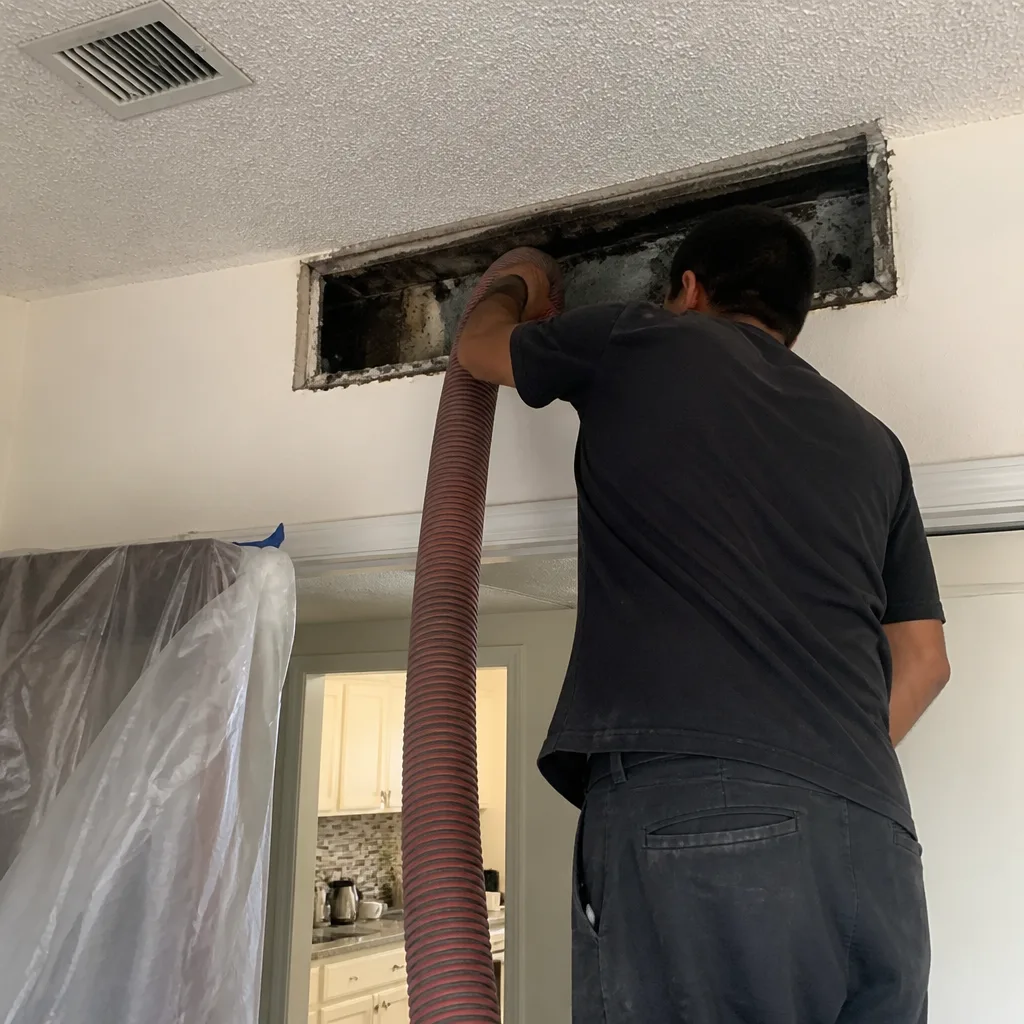 Before
 After
After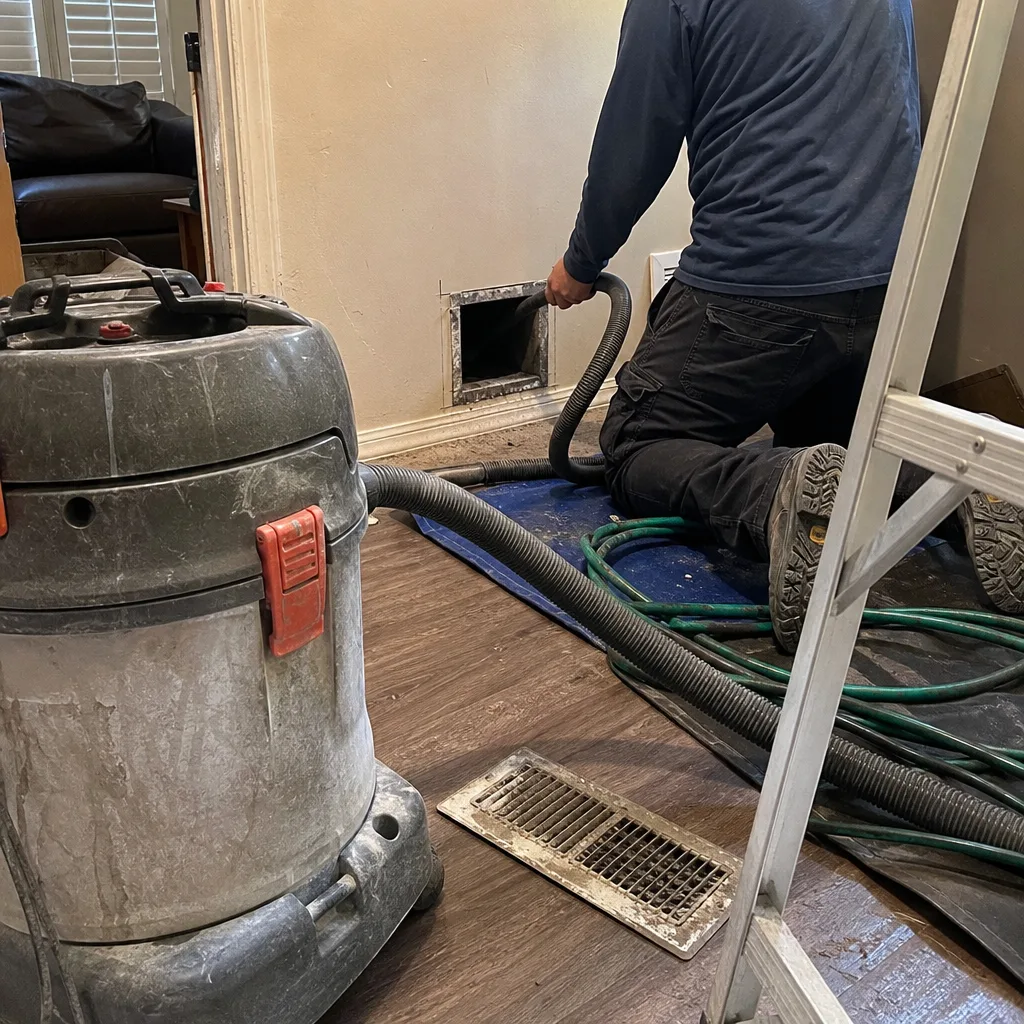 Before
 After
After